Epoxy Flooring

Basement Waterproofing, Epoxy Flooring, Polyurethane Coating

Warehouse Floor Repair: How to Fix Cracks, Dusting & Surface Damage

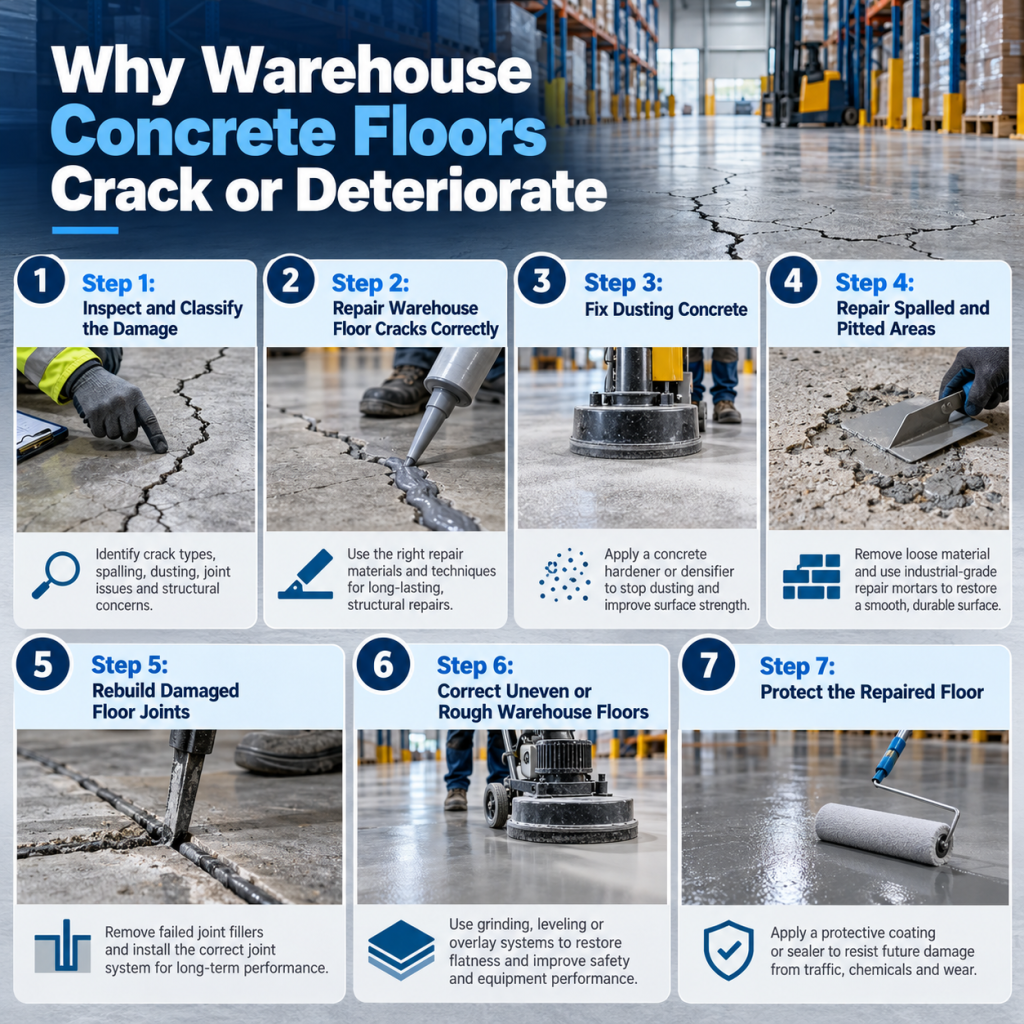
A warehouse floor works harder than most people realise. Every day it carries racks, pallets, forklifts, pallet trucks, loading operations and repeated turning traffic. When the concrete starts cracking, dusting or breaking around joints, the problem is more than cosmetic. Floor damage can slow material movement, increase housekeeping, damage forklift wheels and create safety or maintenance concerns. The most effective warehouse floor repair begins with diagnosis. A crack caused by drying shrinkage should not be treated in the same way as a joint that has broken under hard wheels, and a dusty surface needs a different approach from a spalled or uneven slab. The repair method should match the cause, depth and movement of the defect. Common Signs Your Warehouse Floor Needs Repair Visible cracks that are widening, branching or repeatedly reopening. Concrete dust collecting on racks, goods or forklift routes. Broken joint edges or “shoulder” damage where wheels strike the joint. Spalling, pitting or localised surface loss. Uneven areas that cause vibration during forklift or pallet-truck movement. Coatings that peel, blister or delaminate from the concrete. Low spots where water or cleaning liquid repeatedly ponds. Why Warehouse Concrete Floors Crack or Deteriorate 1. Shrinkage and Concrete Movement Concrete naturally shrinks as it dries. If joint layout, curing or reinforcement does not adequately control movement, cracks may form. Some cracks remain stable; others continue to move and require a different repair strategy. 2. Repeated Forklift and Hard-Wheel Traffic Forklift wheels and pallet trucks can create concentrated abrasion and impact, especially at joints, turning areas, loading zones and dock approaches. Small hard wheels are particularly demanding on weak joint edges and surface mortar. 3. Weak Surface Layer or Dusting Dusting occurs when the top surface of concrete loses integrity and releases fine particles. Causes can include weak surface paste, poor curing, abrasion, finishing issues or long-term wear. Simply painting over a friable surface may trap the problem rather than solve it. 4. Impact and Dropped Loads Pallets, tools, metal parts and loading equipment can chip or spall concrete. Once the edge of a defect breaks, repeated wheel traffic can enlarge it rapidly. 5. Moisture and Contamination Oil, grease, chemicals and moisture can interfere with repair materials and resin coatings. A floor that appears dry on the surface may still have moisture vapour moving through the slab, so testing may be needed before installing an impermeable coating. 6. Settlement or Structural Movement Cracks with vertical displacement, progressive opening, differential settlement or unusual patterns can indicate a deeper structural or sub-base issue. These conditions should be evaluated by a qualified structural professional before cosmetic repair is attempted. Step 1: Inspect and Classify the Damage A professional survey should map cracks, joints, spalled areas, dusting and uneven zones. It is useful to note where damage occurs in relation to rack legs, forklift turning points, loading bays, doorways and drains. The objective is to decide whether the defect is stable or active, superficial or deep, isolated or widespread. Measure crack width and check whether the two sides are level. Identify contamination from oil, grease, chemicals or tyre deposits. Check whether joint sealant has failed or the concrete arris has broken. Evaluate the surface for weak laitance, hollow areas or coating delamination. Review drainage, moisture and any recurring source of water. Step 2: Repair Warehouse Floor Cracks Correctly Crack repair starts by understanding movement. Stable non-structural cracks can often be routed or prepared and filled with a compatible resin or repair material. Moving joints and active cracks need materials and detailing that allow the intended movement. Structural cracks may require engineering assessment and a structural repair method rather than a surface filler. Important: Do not rigidly fill a designed movement joint simply to make the floor look seamless. Joints exist to accommodate movement, and the repair should respect their function. Step 3: Fix Dusting Concrete The correct dusting treatment depends on how weak the surface is. Light dusting may be improved after thorough cleaning and mechanical preparation using a suitable concrete densifier or protective system. Severe dusting may require removal of the weak layer by grinding or shot blasting followed by resurfacing, a resin system or a new wearing layer. Applying coating directly onto loose powder is likely to result in weak adhesion. Before choosing a densifier, epoxy, or other overlay, check whether the slab has sufficient surface strength and whether moisture is present. The aim is to bond to sound concrete, not to a weak layer that can separate from the slab. Step 4: Repair Spalled and Pitted Areas Spalls and pothole-like defects should be cut or mechanically prepared back to sound concrete. Loose edges are removed, the repair area is cleaned and a compatible high-strength repair mortar or resin mortar is installed according to the required depth and traffic conditions. Feather-edge patches are vulnerable in heavy wheel paths unless the chosen repair product is specifically designed for that detail. Step 5: Rebuild Damaged Floor Joints Joint damage is one of the most common problems in active warehouses. When joint shoulders break down, forklift wheels repeatedly strike the damaged edge, making the defect larger. Repair may involve removing unsound concrete, rebuilding the arris with a high-strength repair material and installing a joint filler or sealant suitable for the expected movement and wheel traffic. Step 6: Correct Uneven or Rough Warehouse Floors Uneven floors can increase vibration, reduce operator comfort and create problems for high-level material handling. Local high spots can sometimes be ground, while low or damaged areas may need a repair screed or self-levelling material. Large-scale flatness problems may require a broader engineered solution, especially in narrow-aisle warehouses where floor tolerances directly affect vehicle performance. Step 7: Protect the Repaired Floor Once structural and surface defects are addressed, a protective finish can reduce future abrasion and improve cleaning. Depending on the duty, options may include concrete densification, dry-shake hardeners on new work, epoxy flooring, PU systems, heavy-duty resin mortar or renewed industrial concrete/VDF flooring. The right choice depends on traffic, impact, chemicals, moisture,
PU vs Epoxy Flooring for Car Parking: Which Is Better for Commercial Buildings
Epoxy Flooring

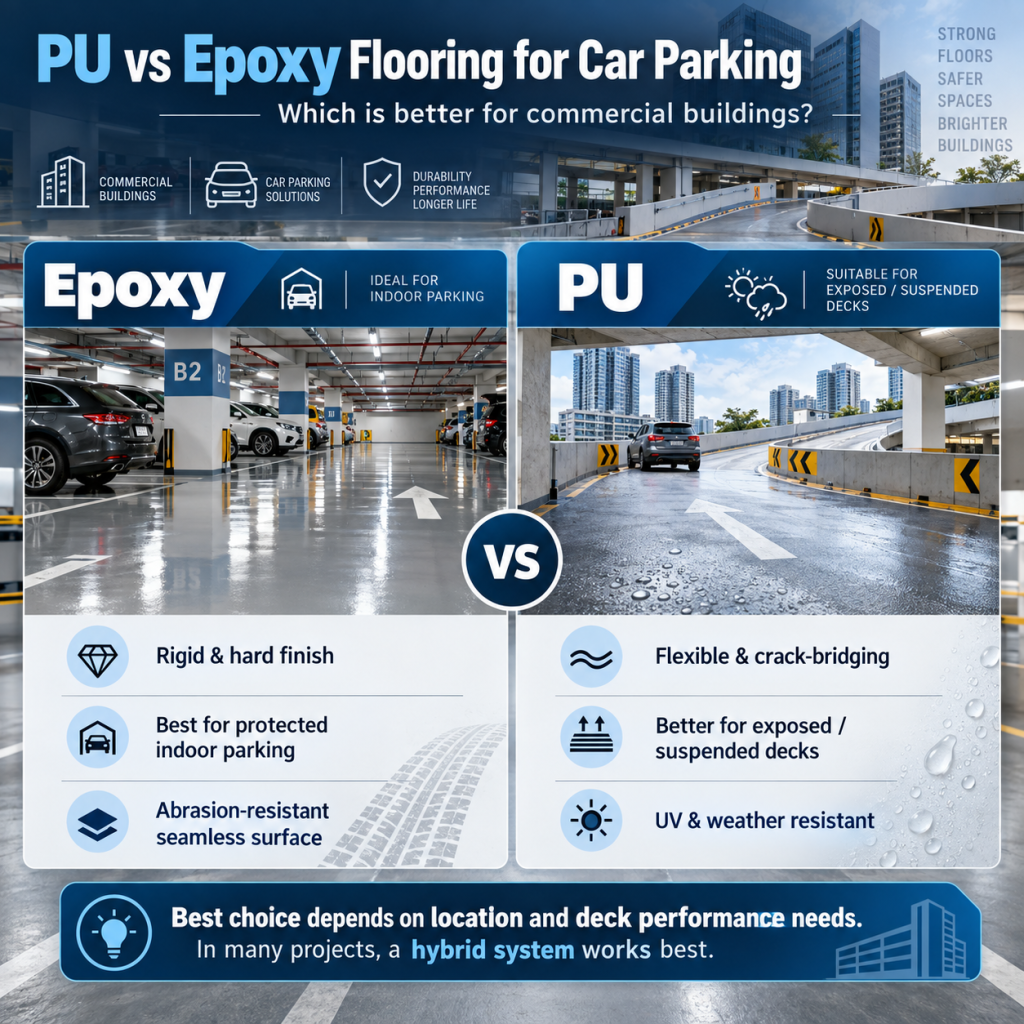
PU vs Epoxy Flooring for Car Parking: Which Is Better for Commercial Buildings?

Commercial car parking floors face continuous tyre traffic, turning forces, oil stains, water, dirt, ramps, drainage and frequent cleaning. In podiums and multi-level car parks, the floor may also sit over occupied spaces and therefore needs to work with waterproofing and crack movement. This is why the choice between PU and epoxy flooring should be based on where the parking area is located and what performance the deck requires not simply on which material is more popular. Epoxy and polyurethane are both proven resin technologies, but they behave differently. Epoxy systems are generally rigid, hard and highly suitable for protected indoor concrete where an abrasion-resistant finish is required. PU-based car-park systems can provide greater flexibility, crack-bridging and UV/weather resistance when designed for suspended, exposed or movement-prone decks. Some car-park specifications intentionally combine epoxy primers with polyurethane wearing or waterproofing layers, so the best answer can also be a hybrid system. What Is Epoxy Flooring for Car Parking? Epoxy flooring is created by combining an epoxy resin with a hardener to form a strong bonded surface over prepared concrete. Car-parking epoxy systems may use primers, body coats, broadcast aggregates and topcoats to achieve the required thickness and slip resistance. Epoxy is especially useful in protected indoor locations where the concrete is stable and the main requirements are wear resistance, cleanliness, colour zoning and easy maintenance. Key Advantages of Epoxy Parking Floors Hard, seamless surface with good resistance to routine tyre and pedestrian traffic when correctly specified. Good adhesion to mechanically prepared concrete. Easy-to-clean finish compared with dusty bare concrete. Can incorporate broadcast aggregate for slip resistance on drive lanes and ramps. Useful for colour coding bays, pedestrian paths, arrows and different parking zones. Available in different build-ups for light to higher-duty internal parking applications. What Is PU Flooring for Car Parking? Polyurethane car-parking systems are typically more elastic than rigid epoxy coatings and can be designed to accommodate movement, bridge cracks and resist UV exposure. Dedicated PU deck systems are widely used on intermediate and exposed parking decks where waterproofing, flexibility and weather resistance are important. Depending on the system, a PU floor may include a primer, elastic membrane, wearing layer, aggregate broadcast and UV-stable topcoat. Key Advantages of PU Parking Floors Greater flexibility and crack-bridging capability in suitable deck systems. Waterproofing options for suspended podiums and decks over occupied areas. UV-stable and weather-resistant topcoat options for exposed parking areas. Good mechanical and abrasion performance in properly designed car-park systems. Slip-resistant textured finishes can be created with broadcast aggregate. Useful on ramps, podiums and dynamic deck areas where movement must be considered. PU vs Epoxy Flooring: Main Differences Factor Epoxy Flooring PU Flooring / Deck System Rigidity / flexibility Generally more rigid and hard Generally more flexible; some systems designed for crack bridging Best environment Protected indoor / stable concrete Podiums, suspended decks, ramps and exposed areas when suitably specified UV exposure Standard epoxy may yellow/chalk without suitable UV-stable finish UV-stable PU/topcoat systems are available for exposed decks Waterproofing Can be impermeable but not every epoxy floor is a waterproof deck membrane Dedicated PU systems can include elastic waterproofing membranes Slip resistance Broadcast aggregate can create anti-skid texture Broadcast aggregate can create anti-skid texture Mechanical wear Good to high depending on build-up Good to high depending on car-park system Crack movement Rigid systems have limited movement accommodation Elastic systems can provide greater crack-bridging capability Maintenance Seamless and cleanable Seamless and cleanable; topcoat may be renewed as part of maintenance Which Is Better for Basement Car Parking? For a dry, protected basement on a stable slab, epoxy can be an efficient and durable solution. It provides a clean finish, improves light reflection, supports colour zoning and is easy to maintain. A textured epoxy broadcast system can also improve traction on drive lanes. However, basements often have moisture challenges. Before installing epoxy, the substrate should be tested and any water ingress or vapour problem should be addressed. If the basement structure requires waterproofing or the deck has significant movement, a different membrane or flexible system may be needed beneath or instead of a conventional epoxy coating. Which Is Better for Podium and Intermediate Deck Parking? Podium and suspended intermediate decks behave differently from ground-bearing slabs because they can experience structural movement and may be located over occupied spaces. In these situations, elastic PU or hybrid car-park deck systems are often preferred where crack bridging and waterproofing are part of the specification. Dedicated systems can combine an epoxy primer with PU membrane and wearing layers to achieve both adhesion and flexibility. Which Is Better for Exposed Top Deck Parking? Exposed parking decks must deal with sunlight, rain, temperature changes and traffic at the same time. A UV-stable, crack-bridging and waterproof car-park system is generally more appropriate than a standard indoor epoxy finish. PU, polyaspartic or hybrid deck systems are commonly designed for these conditions. The exact system should be selected for local climate, deck movement and drainage requirements. What About Car Parking Ramps? Ramps experience braking, acceleration and turning forces that are more aggressive than normal parking bays. The surface should therefore be designed for high wear and slip resistance. Both epoxy and PU technologies can be used in ramp systems when they include the correct broadcast aggregate and wear layer, but movement, UV exposure and waterproofing needs should guide the final chemistry. How to Choose Between PU and Epoxy for a Commercial Building 1. Is the Area Exposed to Sun and Weather? For exposed podiums and top decks, specify a system with confirmed UV stability and weather resistance. Standard epoxy without a UV-stable protective finish may change colour under prolonged sunlight. 2. Is the Deck Suspended? Suspended decks can move and crack. If waterproofing and crack bridging are required, an elastic deck system is usually more suitable than a rigid decorative coating. 3. Is Moisture Present? Identify leaks, rising moisture and drainage problems before coating. Coating over a wet or contaminated substrate can lead to blistering or adhesion loss. 4. How Heavy

Epoxy Flooring Thickness Guide: 1mm, 2mm, 3mm & 5mm Explained
Epoxy Flooring

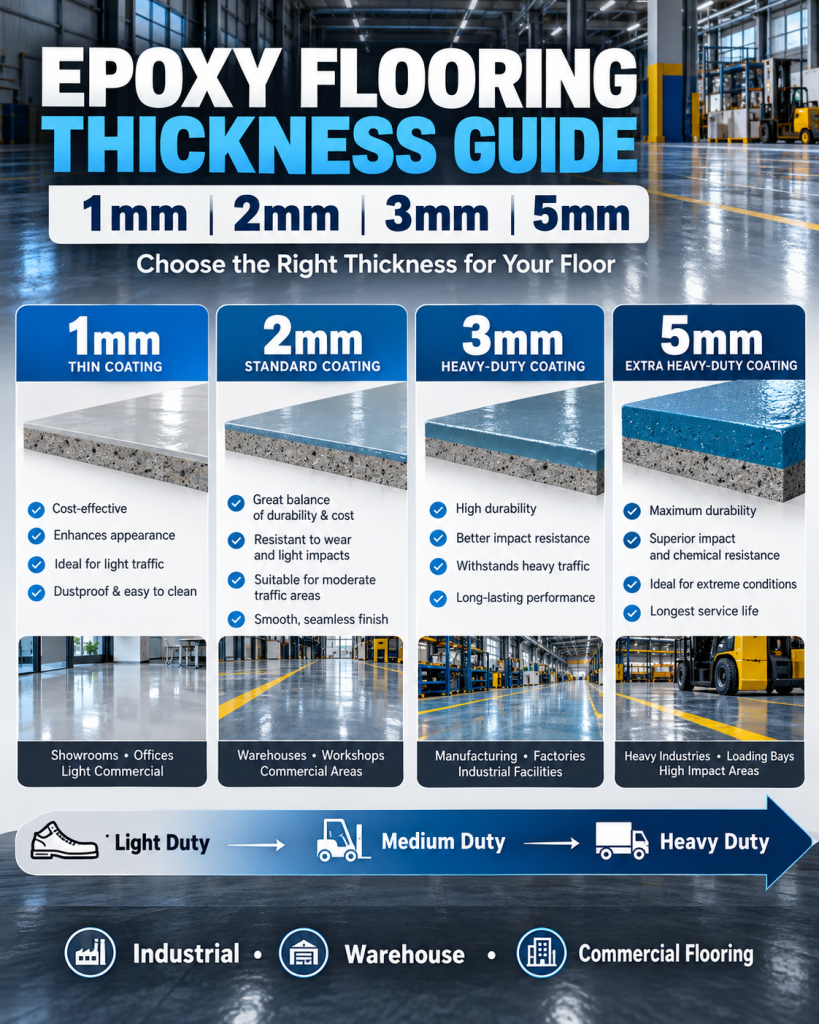
Epoxy Flooring Thickness Guide: 1mm, 2mm, 3mm & 5mm Explained

Choosing epoxy flooring is not only about colour, gloss or price. One of the most important decisions is the thickness of the flooring system. A floor that is too light for the actual operating conditions can wear prematurely, while an unnecessarily heavy system may increase project cost without adding useful performance. For factories, warehouses, workshops, commercial buildings and car parking areas, the right epoxy flooring thickness should be selected according to how the floor will actually be used. Epoxy systems are available in different build-ups, from relatively thin protective coatings to self-smoothing and broadcast systems several millimetres thick. Manufacturer data for industrial systems commonly spans approximately 1–2 mm for some coating systems, 2–4 mm for self-smoothing systems, and thicker broadcast or heavy-duty systems that can reach around 4–6 mm. The practical choice should therefore be made after evaluating traffic, loading, substrate quality and exposure conditions. Why Epoxy Flooring Thickness Matters Thickness influences how the finished flooring system responds to wear, abrasion, impact and repeated traffic. It can also affect how well the system hides minor surface imperfections and how much material is available as a wearing layer over the concrete base. However, thickness works together with resin quality, aggregate, surface preparation, primer selection, curing and workmanship. A poorly prepared 5 mm system can fail earlier than a correctly prepared thinner system. Wear resistance: higher-duty areas generally need a system designed with a stronger wearing layer, not simply an extra coat of resin. Impact and point loads: workshops and production areas may experience dropped tools, trolley wheels, pallet movement and localised mechanical stress. Chemical exposure: oils, cleaning agents, process chemicals and automotive fluids may require a specific resin chemistry and topcoat. Surface profile: rough, porous or damaged concrete usually needs repairs and levelling before the final epoxy system can perform properly. Slip resistance: ramps, wet zones and production floors may need a broadcast aggregate system rather than a smooth finish. What Does 1mm Epoxy Flooring Mean? A 1 mm epoxy flooring system is at the lighter end of industrial resin flooring. Depending on the product and specification, it may be used where the main requirement is seamless protection, improved cleanability, colour coding and moderate wear resistance. Some commercial epoxy systems are specifically designed to work in the 1–2 mm range. Where 1mm Epoxy Flooring Can Be Suitable Utility rooms, service corridors and controlled indoor areas with relatively light mechanical traffic. Commercial spaces where cleanliness and a seamless finish are more important than heavy impact resistance. Selected production or storage areas with light foot and trolley traffic, subject to the chosen product specification. Refurbishment projects where the substrate is already sound, level and properly prepared. A 1mm system should not be selected only because it has a lower initial cost. If the floor is exposed to frequent forklifts, heavy pallet movement, repeated impact or aggressive chemicals, a higher-duty system may offer better lifecycle value. What Does 2mm Epoxy Flooring Mean? Around 2mm is a common design range for self-smoothing or high-build industrial epoxy systems. It can provide a balance between finish quality, cleanability and mechanical performance for many indoor commercial and industrial applications. Product-specific data sheets should be checked because some systems are designed for a 1–2 mm build, while others start at approximately 2 mm. Typical Applications for 2mm Epoxy Flooring Light-to-medium industrial production areas. Warehouses with moderate material-handling traffic. Workshops and maintenance rooms with controlled mechanical loads. Pharma, healthcare or food-related support areas where , easy-to-clean surface is needed, subject to hygiene and chemical requirements. Indoor commercial floors where appearance and durability are both important. What Does 3mm Epoxy Flooring Mean? A 3mm epoxy system provides a more substantial wearing layer and is often considered for environments with higher traffic and stronger mechanical demands. Industrial flooring systems in the 2–3 mm or 2–4 mm range are commonly available for warehouses and production areas. At this duty level, the specification should consider not only thickness but also abrasion resistance, compressive performance, aggregate grading and the type of traffic wheels operating on the floor. Where 3mm Epoxy Flooring May Be Appropriate Busy warehouses with regular pallet trucks or forklifts. Manufacturing and assembly areas with repeated wheeled traffic. Commercial back-of-house spaces exposed to heavier daily use. Industrial corridors, dispatch areas and selected loading-support zones. Areas requiring a more robust self-smoothing or broadcast finish than a light coating can provide. For forklift routes, turning zones and dock approaches, the wheel type and traffic intensity matter greatly. Hard small wheels can create concentrated stress and abrasion, so these areas may need a broadcast system, resin mortar or a heavy-duty concrete solution rather than a smooth self-levelling epoxy alone. What Does 5mm Epoxy Flooring Mean? At approximately 5mm, the flooring is generally moving into a heavier-duty resin build-up such as a broadcast, filled or resin-mortar system rather than a simple roller-applied coating. Manufacturer systems exist in the 4–6 mm range for environments requiring higher wear resistance, texture or more substantial protection. Applications Where a 5mm System May Be Considered Heavy industrial traffic zones with repeated abrasion and impact. Workshop areas where tools, components or materials may be dropped. Loading, dispatch or turning zones with demanding wheeled traffic. Selected car parking ramps or high-wear areas when the specified system is designed for vehicular use and slip resistance. Industrial locations where a resin mortar or broadcast system is required to build a tougher wearing surface. Even at 5mm, epoxy is still a surface system over a concrete substrate. It cannot compensate for an under-designed structural slab, uncontrolled movement, major settlement or serious moisture problems. Structural and substrate issues should be addressed before coating. 1mm vs 2mm vs 3mm vs 5mm Epoxy Flooring Thickness Typical Duty Common Use Cases Key Consideration 1 mm Light / Selected Medium Duty Utility, commercial and clean indoor areas Requires a sound, well-prepared substrate and suitable product 2 mm Medium Duty Production, storage, workshops and commercial floors Good balance of finish and durability for many indoor areas 3 mm Medium-Heavy Duty Warehouses, manufacturing

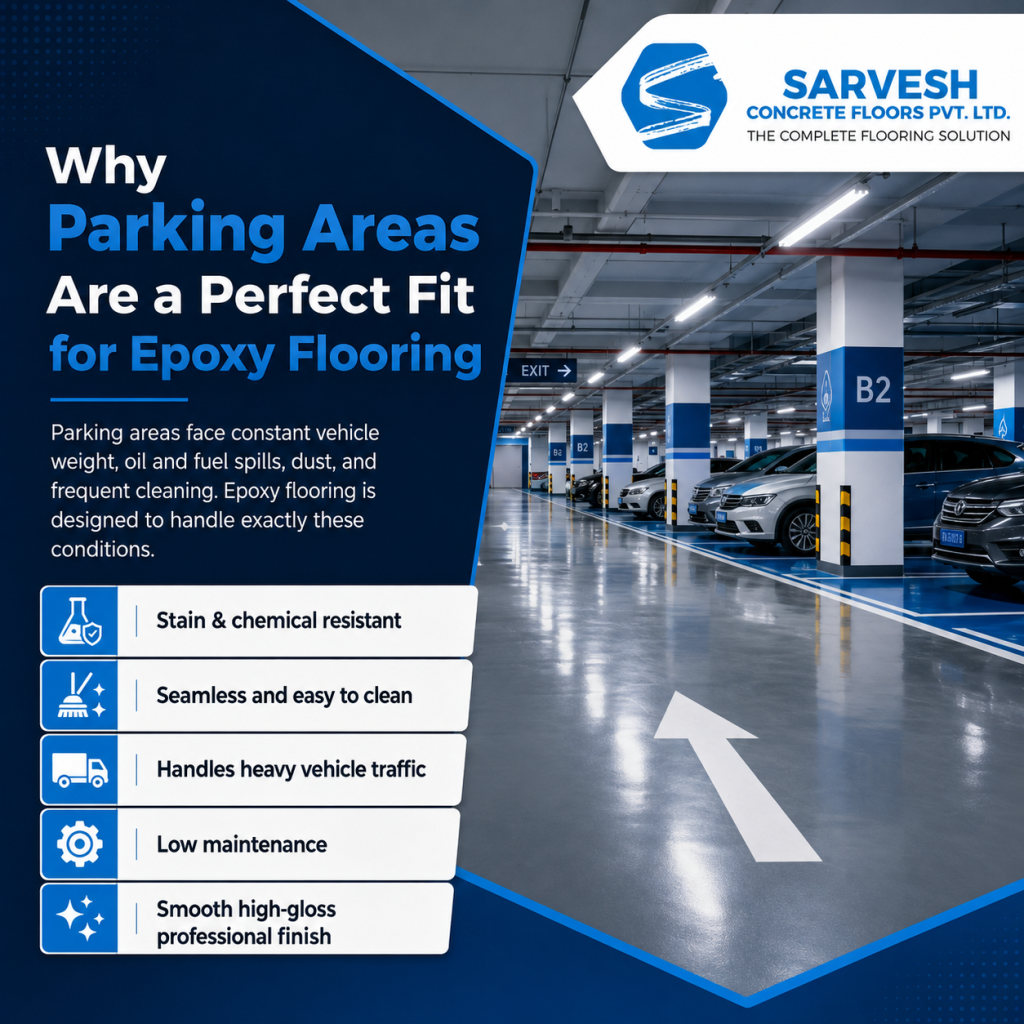
Why Parking Areas Are a Perfect Fit for Epoxy Flooring
Epoxy Flooring

Epoxy Flooring for Car Parking: Why It’s a Smart Choice

Car parking areas go through a lot of wear and tear every single day. Vehicles come in and out constantly, tyres leave marks, oil and fuel sometimes drip onto the floor, and dust builds up quickly. If you have ever looked closely at an older parking area, you may have noticed cracks, stains, and a generally worn-out appearance. This is a very common problem, and it is exactly why more property owners in Mumbai are choosing epoxy flooring for their parking spaces. In this blog, we explain what epoxy flooring is, why it works so well for parking areas, and why it might be the right choice for your property. What Exactly Is Epoxy Flooring Epoxy flooring is not a completely new floor. Instead, it is a special protective coating that gets applied directly on top of an existing concrete surface. Once applied, it bonds tightly with the concrete underneath and forms a smooth, seamless, and very durable layer. Think of it like giving your concrete floor a strong, protective shield that can handle daily wear much better than plain concrete alone Why Parking Areas Are a Perfect Fit for Epoxy Flooring Parking areas face a unique combination of challenges that plain concrete struggles with over time: constant vehicle weight, oil and fuel spills, dust, and frequent cleaning. Epoxy flooring is specifically designed to handle exactly these kinds of conditions. Stain and chemical resistant, so oil, fuel, and other spills do not damage the surface A seamless, dust-free finish that is much easier to clean than plain concrete Strong enough to handle heavy vehicle traffic without cracking or wearing down quickly Low maintenance, since it just needs regular cleaning to stay in good condition A smooth, high-gloss finish that gives the parking area a clean, professional look Where Epoxy Flooring Works Best Epoxy flooring is a flexible solution that works well across many different types of parking spaces, not just one type of property. For Residential Buildings and Societies Epoxy flooring protects the parking floor from oil stains left by resident vehicles and keeps the area looking clean and well maintained for years, without needing constant touch-ups. For Commercial and Industrial Properties Commercial and industrial parking zones often deal with heavier vehicles and much higher traffic. Epoxy flooring is built to handle this kind of constant, heavy use without breaking down quickly, which makes it a practical choice for businesses too. Why It Makes Sense as a Long-Term Investment Some property owners hesitate because epoxy flooring requires a proper installation process upfront. But it is worth looking at the bigger picture. A well-installed epoxy floor can last for many years with very little maintenance, which means far fewer repair costs down the line compared to a plain concrete floor that keeps cracking and staining. In simple terms, you are paying once for a floor that protects itself, instead of paying again and again to fix a floor that keeps wearing down. Why Choose SACOF for Epoxy Flooring Sarvesh Concrete Floors Pvt. Ltd. has completed epoxy flooring projects for residential, commercial, and industrial parking areas across Mumbai, Navi Mumbai, and Thane. With 26 years of experience, we know how to deliver a smooth, durable, seamless finish that is built to handle daily wear and tear. Need expert flooring work done right? Call Sarvesh Concrete Floors Pvt. Ltd. at +91 88505 63804 or email Mdsarvesh@sacof.in for a free site inspection.

Epoxy Flooring

Why Pharma and Food Companies Need Strong Industrial Floors

If you run or manage a pharma company or a food processing unit, you already know how important cleanliness and safety are. But there is one part of the building that people often forget about, and that is the floor. The floor is actually one of the most important parts of a pharma or food facility. It touches everything: the machines, the raw materials, the workers, and even the final product. In this blog, we will explain in simple words why a strong industrial floor matters so much for these industries, what problems a weak floor can cause, and what kind of flooring works best. Why the Floor Is So Important in Pharma and Food Units Think about what happens on the floor of a pharma or food factory every single day. Heavy machines move across it. Trolleys carrying raw materials roll over it. Workers walk on it all day long. Chemicals and cleaning liquids get spilled on it. And it gets washed and scrubbed again and again to keep it clean. A normal floor, like the kind used in a house or a regular office, simply cannot handle this much daily stress. Over time, it develops cracks, becomes rough, and starts to wear down. Once that happens, it becomes a real problem, not just for the floor, but for the whole business. What Can Go Wrong with a Weak Floor problems it can lead to: Dust and bacteria can build up inside cracks and joints, which is a serious risk in pharma and food units where cleanliness is critical Chemical spills, like cleaning agents or acids, can slowly eat away at untreated concrete Rough or uneven surfaces are much harder to clean properly, no matter how much you scrub Heavy equipment and trolleys can crack or wear down a weak floor faster than expected Frequent repairs mean the factory has to stop work again and again, which costs time and money In short, a weak floor does not just look bad. It can actually put the safety of your products and your workers at risk. What Makes a Good Floor for Pharma and Food Companies A good industrial floor for these industries needs to do a few things very well. It should be smooth and seamless, so there are no gaps where dirt or bacteria can hide. It should be easy to clean, even with strong chemicals. It should be strong enough to handle heavy machines and constant footfall. And it should last for many years without breaking down. Why Epoxy Flooring Is a Popular Choice One of the most trusted flooring options for pharma and food factories is epoxy flooring. This is a special coating applied over the concrete base, which creates a smooth, glossy, and completely seamless surface. Because there are no joints or gaps, dust and bacteria have nowhere to settle. Seamless and dust-free finish that is easy to keep clean Strong resistance to chemicals, oils, and spills Simple to clean and maintain, even with daily washing Long-lasting, even with constant heavy use Meets the strict hygiene standards that pharma and food industries must follow Other Flooring Options for Factories Along with epoxy flooring, some pharma and food units also use VDF, which stands for Vacuum Dewatered Flooring, or industrial screed flooring. These are used in areas that need extra strength, such as loading zones or heavy machinery areas, where the floor needs to handle very heavy weight without cracking. A Simple Way to Think About It It helps to think of the floor as an investment, not just a construction cost. A strong, well-built floor may cost a little more at first, but it saves a lot of money over the years by avoiding repeated repairs, factory downtime, and hygiene problems. For pharma and food companies especially, the cost of a contamination issue or a safety incident is far higher than the cost of a good floor. Why Choose SACOF for Pharma and Food Industry Flooring Sarvesh Concrete Floors Pvt. Ltd. has over 26 years of experience building industrial flooring for factories across Mumbai. We understand the strict hygiene and safety standards that pharma and food companies must follow, and we build floors that are strong, easy to clean, and made to last. Need expert flooring work done right? Call Sarvesh Concrete Floors Pvt. Ltd. at +91 88505 63804 or email Mdsarvesh@sacof.in for a free site inspection.

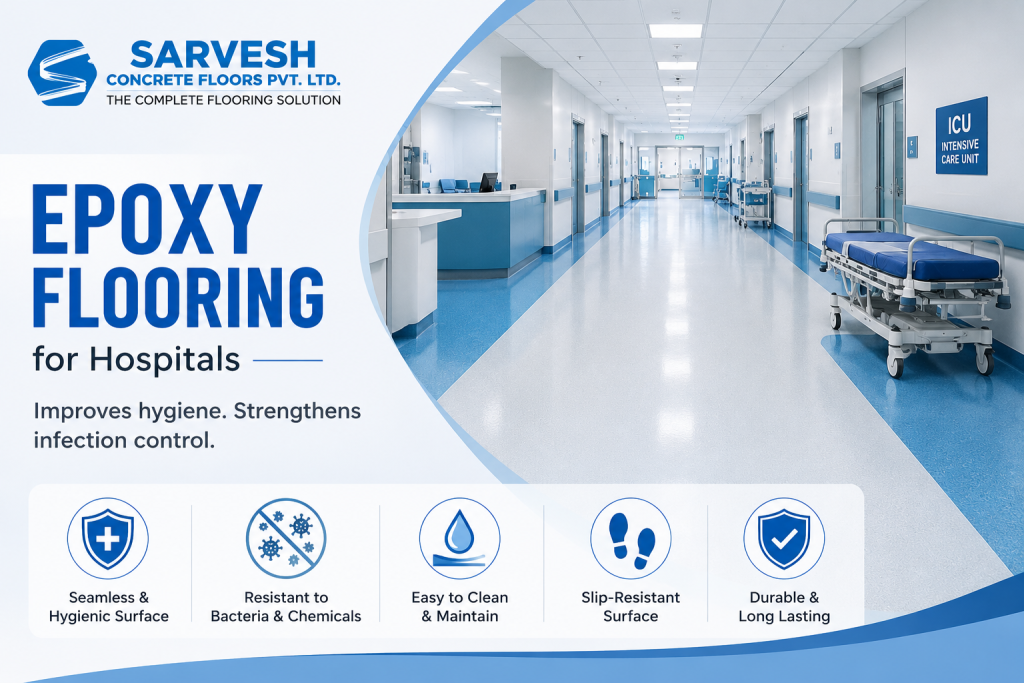
Why Hygiene Matters in Healthcare Flooring Hospital floors are exposed daily to bacteria, viruses, blood, bodily fluids, chemicals, medical waste, and continuous foot traffic. Traditional flooring materials often contain joints, grout lines, or cracks where dirt, moisture, and harmful microorganisms can accumulate, making effective cleaning more difficult. A healthcare flooring system should: Prevent bacterial growth Be easy to clean and disinfect Resist chemicals and stains Minimise dust accumulation Withstand heavy foot and equipment traffic Provide a safe, slip-resistant walking surface Epoxy flooring meets all these requirements, making it one of the preferred flooring systems for modern healthcare facilities.
Epoxy Flooring

How Epoxy Flooring Improves Hospital Hygiene and Infection Control

Hospitals are among the most demanding environments when it comes to cleanliness, safety, and infection prevention. Every surface within a healthcare facility must help reduce the risk of contamination while withstanding constant foot traffic, heavy medical equipment, frequent cleaning, and exposure to harsh disinfectants. Flooring plays a crucial role in maintaining these high hygiene standards. Epoxy flooring has become one of the most trusted flooring solutions for hospitals because it creates a seamless, durable, and hygienic surface that supports infection control while reducing long-term maintenance costs. From operating theatres and intensive care units (ICUs) to laboratories, emergency departments, patient wards, and hospital corridors, epoxy flooring helps create a safer environment for patients, healthcare professionals, and visitors. Why Hygiene Matters in Healthcare Flooring Hospital floors are exposed daily to bacteria, viruses, blood, bodily fluids, chemicals, medical waste, and continuous foot traffic. Traditional flooring materials often contain joints, grout lines, or cracks where dirt, moisture, and harmful microorganisms can accumulate, making effective cleaning more difficult. A healthcare flooring system should: Prevent bacterial growth Be easy to clean and disinfect Resist chemicals and stains Minimise dust accumulation Withstand heavy foot and equipment traffic Provide a safe, slip-resistant walking surface Epoxy flooring meets all these requirements, making it one of the preferred flooring systems for modern healthcare facilities. Key Benefits of Epoxy Flooring for Hospitals 1. Non-Porous Surface Unlike tiled flooring, epoxy flooring creates a smooth, joint-free surface without grout lines or cracks where bacteria can hide. This seamless finish significantly reduces the chances of contamination and makes routine cleaning much more effective. 2. Supports Infection Control Effective infection control is essential in hospitals. Since epoxy flooring does not absorb liquids or contaminants, spills can be cleaned quickly before bacteria have an opportunity to spread. This helps healthcare facilities maintain strict hygiene protocols. 3. Easy Cleaning and Low Maintenance Hospital floors require frequent cleaning using powerful disinfectants. Epoxy flooring withstands regular washing, scrubbing, and sanitising without losing its finish. Its smooth surface allows housekeeping staff to clean more efficiently while reducing maintenance time and costs. 4. Excellent Chemical Resistance Healthcare facilities use a wide range of cleaning agents, disinfectants, and medical chemicals every day. Epoxy flooring is highly resistant to these substances, helping preserve the floor’s appearance and structural integrity even under constant exposure. 5. High Durability Under Heavy Traffic Hospitals experience continuous movement of patients, staff, stretchers, wheelchairs, hospital beds, and medical equipment. Epoxy flooring is designed to withstand heavy loads and constant traffic without cracking, chipping, or wearing out quickly, making it a long-term investment. A healthcare flooring system should: Prevent bacterial growth Be easy to clean and disinfect Resist chemicals and stains Minimise dust accumulation Withstand heavy foot and equipment traffic Provide a safe, slip-resistant walking surface Epoxy flooring meets all these requirements, making it one of the preferred flooring systems for modern healthcare facilities. Areas Where Epoxy Flooring is Commonly Used Epoxy flooring is suitable for almost every area within a healthcare facility, including: Operating Theatres (OTs) Intensive Care Units (ICUs) Emergency Rooms Patient Wards Hospital Corridors Diagnostic Laboratories Pharmacies Sterile Storage Areas Medical Equipment Rooms Waiting Areas Why Choose Professional Epoxy Flooring Installation? The performance of epoxy flooring depends heavily on proper installation. Professional installation ensures: Proper concrete surface preparation Strong bonding and adhesion Uniform coating thickness Smooth, seamless finish Long-lasting durability Compliance with healthcare hygiene standards Experienced installers also recommend the most suitable epoxy flooring system based on the functional requirements of each hospital area. Conclusion Maintaining hygiene and preventing infections are top priorities for every healthcare facility. Epoxy flooring provides a seamless, durable, chemical-resistant, and easy-to-clean surface that supports strict hospital hygiene standards while improving safety and reducing maintenance costs. Whether you’re constructing a new hospital or upgrading an existing healthcare facility, epoxy flooring is a reliable long-term investment that enhances cleanliness, protects patients and healthcare staff, and delivers outstanding performance for years. Contact Sarvesh Concrete Floors Pvt. Ltd. Looking for reliable epoxy flooring solutions for hospitals, healthcare facilities, laboratories, industrial plants, or commercial projects? Sarvesh Concrete Floors Pvt. Ltd. brings over 26 years of expertise in delivering durable, hygienic, and high-performance flooring solutions across Mumbai.

Epoxy Flooring

The Benefits of Polyurethane Coating for Modern Car Parking Spaces

As urban areas continue to evolve, the need for modern, efficient, and safecar parking spaces has become increasingly crucial. Car parking is no longerjust about providing a place to park a vehicle; it’s about creating spaces thatare durable, aesthetically pleasing, and sustainable. One of the best solutionsfor enhancing modern parking spaces is the use of polyurethane coating. Intoday’s world, modern car parking spaces are not just functional areas; theyare integral parts of residential complexes, commercial buildings, andindustrial facilities. These spaces need to endure heavy vehicle traffic,resist wear and tear, and maintain their aesthetics over time. Polyurethanecoating has emerged as a preferred solution for addressing these challenges.Let’s explore the numerous benefits of polyurethane coating for modern carparking spaces. 1. Unmatched Durability for High-Traffic Areas Car parking spaces are subject to constant vehicular movement, heavy loads, and the inevitable wear and tear associated with daily use. Polyurethane coatings are specifically designed to provide superior durability in such environments. Unlike traditional flooring solutions, polyurethane offers excellent resistance to abrasion, impact, and pressure, ensuring that the surface remains intact and functional even under the most demanding conditions. 2. Superior Weather Resistance for Longevity Parking facilities, especially those located outdoors or in open-air podiums, are constantly exposed to varying weather conditions, from intense sunlight to unpredictable rainfall. Polyurethane coatings are highly resistant to UV radiation, ensuring that they will not fade or degrade when exposed to prolonged sunlight. Additionally, these coatings are waterproof, effectively preventing moisture from seeping into the substrate beneath, thus avoiding potential structural damage caused by water penetration. 3. Easy maintenance with a polished finish The maintenance of car parking spaces, especially large multi-level parking facilities, can be a significant challenge. Cleaning and upkeep can become time-consuming and costly, particularly when the flooring has visible seams, joints, or gaps where dirt and debris accumulate. Polyurethane coatings offer an application that eliminates the need for joints, making the entire surface smooth and continuous. 4. Exceptional Chemical Resistance for Protection In parking spaces, exposure to various chemicals is inevitable. Substances like oil, fuel, cleaning agents, and other automotive fluids can quickly damage conventional flooring materials, leading to stains, corrosion, or surface degradation. Polyurethane coatings provide superior chemical resistance, preventing these substances from affecting the integrity of the surface. 5. Aesthetic Flexibility for Modern Design First impressions matter, especially in commercial and residential properties. A well-maintained, visually appealing parking space can positively influence visitors, tenants, and customers alike. Polyurethane coatings offer unparalleled aesthetic flexibility, allowing property owners to choose from a wide range of colors, finishes, and textures to suit the overall design of the facility. 6. Slip Resistance for Safety and Security Ensuring safety within car parking spaces is a priority, particularly when dealing with wet or slippery surfaces. Polyurethane coatings can be modified to include slip-resistant properties, creating a safer environment for both pedestrians and vehicles. This is especially important in areas prone to oil spills, rainwater, or snow, which can make surfaces slippery and increase the risk of accidents. 7. Cost-Effective Long-Term Solution While the upfront cost of applying polyurethane coating may be higher compared to other flooring options, the long-term benefits far outweigh the initial investment. The durability, low maintenance requirements, and extended lifespan of polyurethane coatings translate into significant cost savings over time. Property owners can avoid the recurring expenses of repairs, resurfacing, or premature replacement typically associated with conventional flooring solutions. 8. Environmentally Friendly Solutions In today’s eco-conscious world, choosing sustainable building materials is more important than ever. Modern polyurethane coatings are formulated to be more environmentally friendly than ever before. Many products are low in volatile organic compounds (VOCs), which contribute to air pollution and can be harmful to both the environment and the health of the people involved in the installation process. 9. Quick Installation and Minimal Disruption In high-traffic areas, minimizing downtime during installation is crucial. Polyurethane coatings are designed for quick installation and fast curing times, ensuring minimal disruption to parking operations. This is especially important for businesses that cannot afford to close off large sections of their parking facilities for extended periods. polyurethane coating offers a wealth of advantages for modern car parking spaces. Its impressive durability, resistance to harsh weather conditions, and ability to protect surfaces from stains and spills make it a highly effective choice for both commercial and residential parking areas. Additionally, the aesthetic appeal, customization options, and enhanced safety features such as anti-slip properties and better visibility contribute to a superior parking experience for both drivers and pedestrians. With its low maintenance requirements and long-lasting results, polyurethane coating not only provides immediate benefits but also proves to be a cost-effective solution in the long run. Whether you’re managing an outdoor lot, a multi-story garage, or a residential parking facility, polyurethane coatings are a smart investment that will help maintain the integrity and appearance of the parking space for years to come. At Sarvesh Concrete Floors Pvt. Ltd., we specialize in providing top-quality flooring solutions, including polyurethane coatings, tailored to meet the unique needs of car parking spaces. As expert flooring contractors based in Santacruz East, Mumbai, we are committed to offering durable, high-performance floors that not only meet but exceed your expectations. For more information or to schedule a consultation, feel free to reach out to us:Email: mdsarvesh@sacof.inCall us: +91 8850563804   Let us help you design the perfect parking space solution with polyurethane coatings that offer both superior functionality and visual appeal. Contact us today! Frequently Asked Questions 1. What is polyurethane coating for car parking spaces? Polyurethane coating is a protective layer applied to car parking floors to enhance their durability, resistance to chemicals, weather, and abrasion. It helps maintain the surface integrity and appearance of parking spaces while making them easier to clean and maintain. 2. Why should I choose polyurethane coating for my parking space? Polyurethane coatings offer numerous benefits, including exceptional durability, chemical resistance, weather protection, and slip resistance. They also provide an aesthetically pleasing finish and require less maintenance compared to traditional flooring

Epoxy flooring is a type of resinous surface coating applied to concrete floors to create a durable, high-performance surface
Epoxy Flooring

Top 7 Benefits of Epoxy Flooring for Commercial Spaces

Epoxy flooring is rapidly becoming the preferred choice for commercial spaces due to its durability, aesthetic versatility, and ease of maintenance.Top 7 Benefits of Epoxy Flooring for Commercial Spaces This advanced flooring solution offers numerous benefits that make it ideal for a variety of commercial environments, from warehouses and factories to retail stores and hospitals. Epoxy flooring contributes to its growing popularity among business owners and facility managers seeking a reliable, cost-effective, and visually appealing flooring option. Whether you’re renovating an existing space or constructing a new one, understanding the benefits of epoxy flooring can help you make an informed decision that enhances both the functionality and the aesthetic appeal of your commercial property. What is epoxy flooring? Epoxy flooring is a type of resinous surface coating applied to concrete floors to create a durable, high-performance surface. It is essentially a two-part system consisting of resin, which is a binder that acts as the base of the coating, and a hardener, a catalyst that reacts with the resin to create a strong, rigid surface. When these components are mixed, a chemical reaction occurs, transforming the liquid mixture into a tough, plastic-like material that bonds to the concrete substrate.Here Top 7 Benefits of Epoxy Flooring for Commercial Spaces  Epoxy flooring is highly suitable for a variety of commercial spaces due to its numerous advantages. Here’s a breakdown of why it excels in commercial settings: Exceptional Durability and Strength  Epoxy floors can withstand heavy foot traffic, constant use of machinery, and potential impacts without showing significant wear or tear. This makes them ideal for high-traffic areas like warehouses, factories, retail stores, restaurants, and showrooms.  Superior Chemical Resistance  Unlike some materials that can be damaged by harsh chemicals, epoxy floors are resilient to a wide range of chemicals, including oils, solvents, and acids. This makes them perfect for laboratories, workshops, chemical plants, and other environments where chemical spills are a potential concern.  Easy maintenance and cleaning  The smooth, non-porous surface of epoxy flooring simplifies cleaning and maintenance routines. Regular sweeping, mopping, and occasional degreasing are typically sufficient to keep the floor looking its best. This translates to lower cleaning costs and reduced downtime compared to some other flooring options.With commercial places being very fast-paced and bustling in nature, epoxy flooring is the right solution because it can withstand heavy foot traffic and frequent movement of machinery without showing signs of wear and tear. This resilience makes it an ideal choice for areas that experience constant activity. Contact Sarvesh Concrete Floors Pvt. Ltd. today for epoxy flooring solutions!  Improved Safety  Epoxy flooring offers enhanced slip resistance, minimizing the risk of accidents in areas prone to spills or moisture. This is crucial for commercial spaces where employee and customer safety is a top priority. Additionally, the  surface minimizes gaps where dirt or debris can accumulate, promoting a cleaner and more hygienic environment.  Aesthetics and Customization  Epoxy flooring comes in a wide range of colors and can be finished with decorative flakes or chips to create a visually appealing surface. This allows for customization that can complement the overall design aesthetic of the commercial space, potentially enhancing the brand image or creating a specific ambiance.  Long Lifespan  With proper care and maintenance, epoxy flooring boasts a lifespan exceeding 10–20 years with some minimal maintenance. This translates to a cost-effective flooring solution in the long run, as replacements are less frequent compared to other materials. This can significantly reduce maintenance costs and the downtime associated with floor repairs or replacements.  Versatility across Industries  The benefits of epoxy coatings on flooring extend to a wide range of commercial spaces. From industrial settings like warehouses and factories to retail stores, showrooms, laboratories, and even restaurants, epoxy flooring offers the perfect blend of durability, chemical resistance, easy maintenance, safety features, and aesthetics. Frequently Asked Questions What are the benefits of Trimix Flooring? Superior strength and durability Reduced water and cement consumption Faster construction time Smooth and even surface finish Resistance to abrasion and wear Where can floor self-leveling be used? Where can floor self-leveling be used? Floor self-leveling is suitable for a variety of applications, including: Residential spaces such as living rooms, kitchens, and basements. Commercial environments, including retail stores, offices, and showrooms. Industrial facilities and warehouses where flat and level surfaces are crucial for operations. How is stamped concrete installed? Preparation of the base and ensuring proper compaction. Pouring and leveling the concrete mix. Application of release agents and color hardeners to achieve desired colors and textures. Stamping with textured mats or tools to create patterns and textures. Curing and sealing to enhance durability and color retention. What is the installation process for industrial flooring? Surface preparation, including cleaning and possibly shot blasting or grinding to ensure proper adhesion. Application of the selected flooring system, which may include multiple layers depending on the specifications. Curing and drying time, followed by any necessary finishing touches or coatings.   What is the downtime for installing epoxy flooring? The downtime varies depending on the size of the area, the complexity of the installation, and environmental conditions. In many cases, epoxy flooring can be installed in stages to minimize disruption to operations.

Scroll to Top