Warehouse Floor Repair: How to Fix Cracks, Dusting & Surface Damage
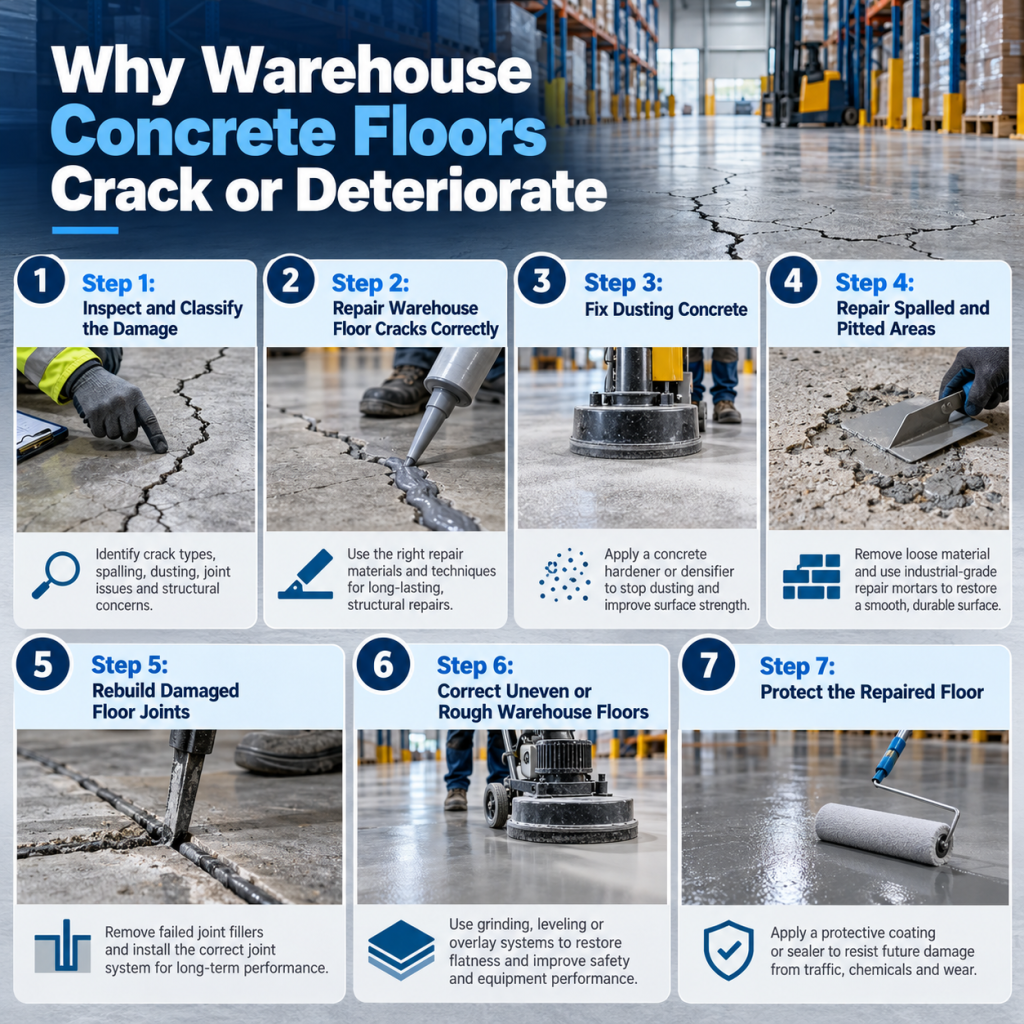
A warehouse floor works harder than most people realise. Every day it carries racks, pallets, forklifts, pallet trucks, loading operations and repeated turning traffic. When the concrete starts cracking, dusting or breaking around joints, the problem is more than cosmetic. Floor damage can slow material movement, increase housekeeping, damage forklift wheels and create safety or maintenance concerns. The most effective warehouse floor repair begins with diagnosis. A crack caused by drying shrinkage should not be treated in the same way as a joint that has broken under hard wheels, and a dusty surface needs a different approach from a spalled or uneven slab. The repair method should match the cause, depth and movement of the defect. Common Signs Your Warehouse Floor Needs Repair Visible cracks that are widening, branching or repeatedly reopening. Concrete dust collecting on racks, goods or forklift routes. Broken joint edges or “shoulder” damage where wheels strike the joint. Spalling, pitting or localised surface loss. Uneven areas that cause vibration during forklift or pallet-truck movement. Coatings that peel, blister or delaminate from the concrete. Low spots where water or cleaning liquid repeatedly ponds. Why Warehouse Concrete Floors Crack or Deteriorate 1. Shrinkage and Concrete Movement Concrete naturally shrinks as it dries. If joint layout, curing or reinforcement does not adequately control movement, cracks may form. Some cracks remain stable; others continue to move and require a different repair strategy. 2. Repeated Forklift and Hard-Wheel Traffic Forklift wheels and pallet trucks can create concentrated abrasion and impact, especially at joints, turning areas, loading zones and dock approaches. Small hard wheels are particularly demanding on weak joint edges and surface mortar. 3. Weak Surface Layer or Dusting Dusting occurs when the top surface of concrete loses integrity and releases fine particles. Causes can include weak surface paste, poor curing, abrasion, finishing issues or long-term wear. Simply painting over a friable surface may trap the problem rather than solve it. 4. Impact and Dropped Loads Pallets, tools, metal parts and loading equipment can chip or spall concrete. Once the edge of a defect breaks, repeated wheel traffic can enlarge it rapidly. 5. Moisture and Contamination Oil, grease, chemicals and moisture can interfere with repair materials and resin coatings. A floor that appears dry on the surface may still have moisture vapour moving through the slab, so testing may be needed before installing an impermeable coating. 6. Settlement or Structural Movement Cracks with vertical displacement, progressive opening, differential settlement or unusual patterns can indicate a deeper structural or sub-base issue. These conditions should be evaluated by a qualified structural professional before cosmetic repair is attempted. Step 1: Inspect and Classify the Damage A professional survey should map cracks, joints, spalled areas, dusting and uneven zones. It is useful to note where damage occurs in relation to rack legs, forklift turning points, loading bays, doorways and drains. The objective is to decide whether the defect is stable or active, superficial or deep, isolated or widespread. Measure crack width and check whether the two sides are level. Identify contamination from oil, grease, chemicals or tyre deposits. Check whether joint sealant has failed or the concrete arris has broken. Evaluate the surface for weak laitance, hollow areas or coating delamination. Review drainage, moisture and any recurring source of water. Step 2: Repair Warehouse Floor Cracks Correctly Crack repair starts by understanding movement. Stable non-structural cracks can often be routed or prepared and filled with a compatible resin or repair material. Moving joints and active cracks need materials and detailing that allow the intended movement. Structural cracks may require engineering assessment and a structural repair method rather than a surface filler. Important: Do not rigidly fill a designed movement joint simply to make the floor look seamless. Joints exist to accommodate movement, and the repair should respect their function. Step 3: Fix Dusting Concrete The correct dusting treatment depends on how weak the surface is. Light dusting may be improved after thorough cleaning and mechanical preparation using a suitable concrete densifier or protective system. Severe dusting may require removal of the weak layer by grinding or shot blasting followed by resurfacing, a resin system or a new wearing layer. Applying coating directly onto loose powder is likely to result in weak adhesion. Before choosing a densifier, epoxy, or other overlay, check whether the slab has sufficient surface strength and whether moisture is present. The aim is to bond to sound concrete, not to a weak layer that can separate from the slab. Step 4: Repair Spalled and Pitted Areas Spalls and pothole-like defects should be cut or mechanically prepared back to sound concrete. Loose edges are removed, the repair area is cleaned and a compatible high-strength repair mortar or resin mortar is installed according to the required depth and traffic conditions. Feather-edge patches are vulnerable in heavy wheel paths unless the chosen repair product is specifically designed for that detail. Step 5: Rebuild Damaged Floor Joints Joint damage is one of the most common problems in active warehouses. When joint shoulders break down, forklift wheels repeatedly strike the damaged edge, making the defect larger. Repair may involve removing unsound concrete, rebuilding the arris with a high-strength repair material and installing a joint filler or sealant suitable for the expected movement and wheel traffic. Step 6: Correct Uneven or Rough Warehouse Floors Uneven floors can increase vibration, reduce operator comfort and create problems for high-level material handling. Local high spots can sometimes be ground, while low or damaged areas may need a repair screed or self-levelling material. Large-scale flatness problems may require a broader engineered solution, especially in narrow-aisle warehouses where floor tolerances directly affect vehicle performance. Step 7: Protect the Repaired Floor Once structural and surface defects are addressed, a protective finish can reduce future abrasion and improve cleaning. Depending on the duty, options may include concrete densification, dry-shake hardeners on new work, epoxy flooring, PU systems, heavy-duty resin mortar or renewed industrial concrete/VDF flooring. The right choice depends on traffic, impact, chemicals, moisture,