
Factory flooring plays an important role in supporting machinery, material handling and daily industrial operations. Over time, heavy loads, forklift traffic, vibration and surface wear can cause concrete flooring to deteriorate.
When factory floors develop cracks, uneven surfaces or damaged coatings, facility owners must decide whether to repair the existing floor or replace it.
Understanding the condition of the floor helps businesses select an appropriate and cost-effective renovation solution.
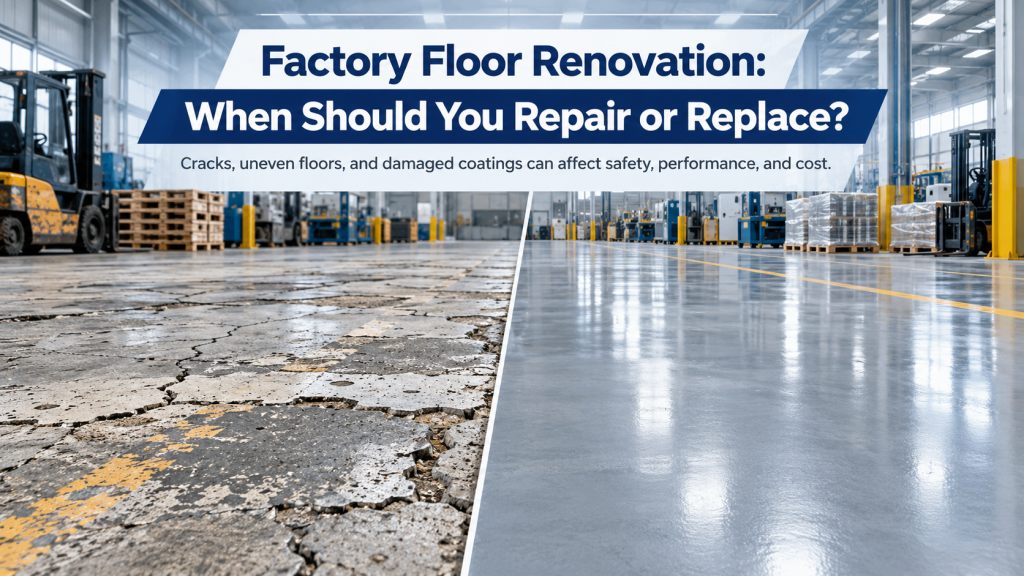
Common Signs Your Factory Floor Needs Renovation
Factory owners should watch for the following problems:
- Widening cracks in concrete surfaces
- Broken or deteriorating floor joints
- Uneven flooring affecting forklift movement
- Peeling or worn epoxy coatings
- Surface dusting and concrete deterioration
- Repeated damage in heavy machinery areas
These issues can affect safety, operational efficiency and flooring performance.
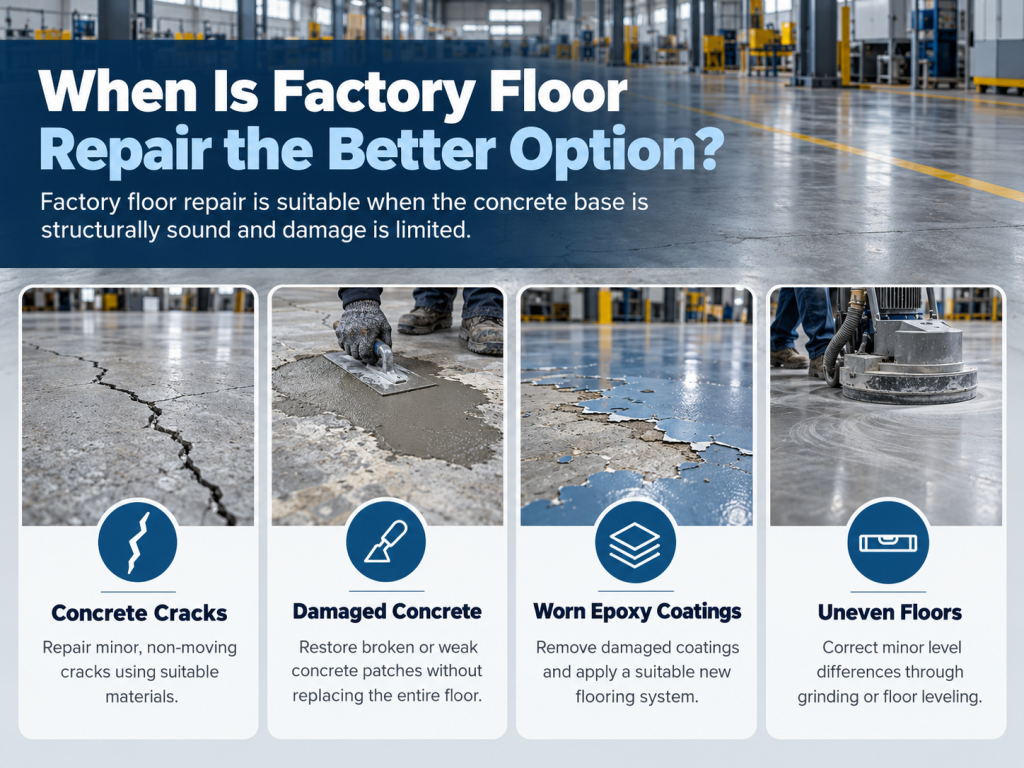
When Is Factory Floor Repair the Better Option?
Repair may be suitable when the underlying concrete remains structurally adequate and damage is limited to specific areas.
Localised Concrete Cracks
Certain non-moving cracks can be repaired using suitable concrete repair materials after identifying their cause.
Damaged Concrete Patches
Small areas of broken or weak concrete can sometimes be removed and restored without replacing the complete floor.
Worn Epoxy Coatings
When the concrete substrate is sound, damaged coatings may be removed and replaced with an appropriate flooring system.
Minor Floor Level Differences
Some uneven areas can be corrected using grinding, local repairs or suitable leveling systems.
When Should Factory Flooring Be Replaced?
Partial or complete replacement may be necessary when:
- Extensive concrete deterioration affects large areas.
- The slab has significant structural defects.
- Severe settlement causes major level differences.
- Existing flooring cannot support required operational loads.
- Repeated repairs fail to address the underlying problem.
Structural concerns should be evaluated by a qualified engineer before deciding on replacement.
Factory Floor Repair vs Replacement
| Factor | Floor Repair | Floor Replacement |
|---|---|---|
| Suitable Damage | Localized | Extensive |
| Initial Cost | Usually lower | Usually higher |
| Operational Disruption | Often less | Often greater |
| Existing Slab | Mostly retained | Partially or fully replaced |
| Best Approach | Sound underlying concrete | Severely damaged or unsuitable slab |
The final decision should consider repair scope, required performance, long-term cost and available shutdown time.
How to Plan Factory Floor Renovation
Before beginning renovation, inspect the existing floor, identify damage causes and assess machinery loads, forklift traffic and operational requirements.
Select the repair or replacement method based on engineering requirements and the condition of the existing concrete.
Scheduling flooring work around production activities can also help minimize unnecessary disruption.
Frequently Asked Questions
Yes. Many factory floors can be restored through crack repair, concrete patching, leveling and suitable resurfacing systems.
The duration depends on floor area, damage severity, repair materials, curing requirements and site accessibility.
Factory Floor Renovation Services in Mumbai
Sarvesh Concrete Floors Pvt. Ltd. provides factory floor renovation, industrial concrete repair and flooring restoration solutions for manufacturing and industrial facilities.
Our team assesses existing floor conditions and recommends appropriate solutions based on operational requirements.
Contact Us: +91 8850563804
Email: Mdsarvesh@sacof.in
Website: https://sacof.in/