Concrete Flooring

Why Societies Are Replacing Old Paver Blocks with Concrete
Concrete Flooring

Why Societies Are Replacing Old Paver Blocks with Concrete

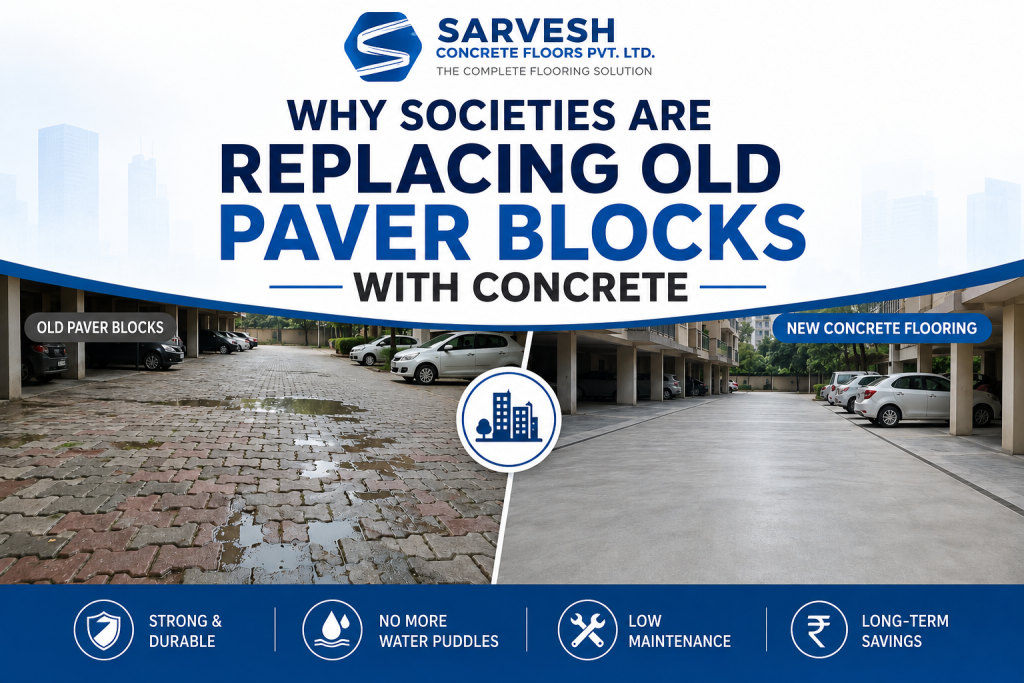
If you live in a housing society that is 20 or 30 years old, you may have noticed that the paver block flooring in the parking area or internal roads is not looking great anymore. Blocks may be sinking, shifting, or cracking, and puddles of water may be collecting after every rain. This is a very common problem, and it is why more and more housing societies across Mumbai are choosing to replace their old paver blocks with concrete flooring. In this blog, we will explain in simple terms why this is happening and why concrete is often the smarter long-term choice. Why Paver Blocks Start Causing Problems Over Time Paver blocks were a popular flooring choice for many housing societies years ago because they were affordable and easy to install. But paver blocks are small individual pieces, and over time, the ground beneath them shifts. This causes the blocks to sink in some areas, tilt in others, and eventually crack or come loose. Once this starts happening, it becomes very difficult to fully fix. You can replace a few blocks here and there, but the problem usually keeps coming back because the base underneath has already weakened. Common Problems Societies Face with Old Paver Blocks Uneven and sinking surfaces that make walking and parking difficult Water collecting in low spots after every rain, especially during Mumbai’s monsoon Loose or broken blocks that need constant repair, month after month Rising maintenance costs, since repairs never really solve the root problem Unsafe surfaces for residents walking, parking, or driving, especially at night or during rain Why Concrete Flooring Solves This Problem Concrete flooring is different because it is laid as one continuous, solid surface instead of many small blocks. This means there are no individual pieces that can shift, sink, or come loose over time. Once concrete flooring is properly laid, it stays strong and level for many years, even with constant vehicle movement. Key Benefits of Concrete Flooring for Societies Much stronger load-bearing capacity, so it easily handles cars and heavier vehicles A smooth, even surface that stays level instead of sinking over time Lower long-term maintenance and repair costs compared to paver blocks Better water drainage, which reduces puddles and water damage A long lifespan, often 20 years or more, with very little upkeep needed Where This Works Best in a Society Concrete flooring is ideal for internal society roads, open parking areas, podium parking, and common walking spaces. Basically, anywhere that sees regular vehicle movement or heavy footfall is a good candidate for this upgrade. How the Replacement Process Usually Works Many society members worry that this kind of work will be disruptive, but a good flooring contractor plans the work carefully to minimise inconvenience. Here is what the process generally looks like: A site inspection to check the current condition of the paver blocks and the ground below Careful removal of the old, damaged blocks Levelling and properly preparing the base surface before laying anything new Laying and finishing the new concrete flooring with the right thickness and strength A final quality check before the area is handed back to the society A Smart, One-Time Investment While replacing paver blocks with concrete does involve an upfront cost, it is really a one-time investment that saves societies a lot of money over the years. Instead of paying for small repairs again and again, societies get a durable surface that simply does not need much attention for a very long time. Why Choose SACOF for Society Flooring Projects Sarvesh Concrete Floors Pvt. Ltd. has helped many housing societies across Mumbai, Navi Mumbai, and Thane move from old, damaged paver blocks to strong, low-maintenance concrete flooring. With 26 years of experience, we know how to plan and complete these projects with as little disruption to residents as possible. Need expert flooring work done right? Call Sarvesh Concrete Floors Pvt. Ltd. at +91 88505 63804 or email Mdsarvesh@sacof.in for a free site inspection. Frequently Asked Questions Why are housing societies replacing old paver blocks with concrete flooring? Old paver blocks can become uneven, sink, crack, shift, and create water-logging problems over time. Concrete flooring provides a stronger, more stable, and long-lasting surface for society roads, parking areas, and common spaces. Is concrete flooring better than paver blocks for society parking? Yes. Concrete flooring offers higher load-bearing strength and provides a continuous, stable surface that can handle regular vehicle movement with less shifting and sinking. How long does concrete flooring last in a housing society? Properly designed and installed concrete flooring can last 20 years or more, depending on the quality of materials, site preparation, traffic load, drainage, and maintenance. Can old paver blocks be completely removed and replaced with concrete? Yes. The existing paver blocks can be removed, the underlying surface can be inspected and prepared, and a suitable concrete flooring system can then be installed. How can I contact SACOF for a site inspection? You can contact Sarvesh Concrete Floors Pvt. Ltd. at +91 88505 63804 or email Mdsarvesh@sacof.in to discuss your society flooring requirement and request a site inspection.
Why Warehouses & Factories Need Waterproof Industrial Flooring
Concrete Flooring

Why Warehouses & Factories Need Waterproof Industrial Flooring

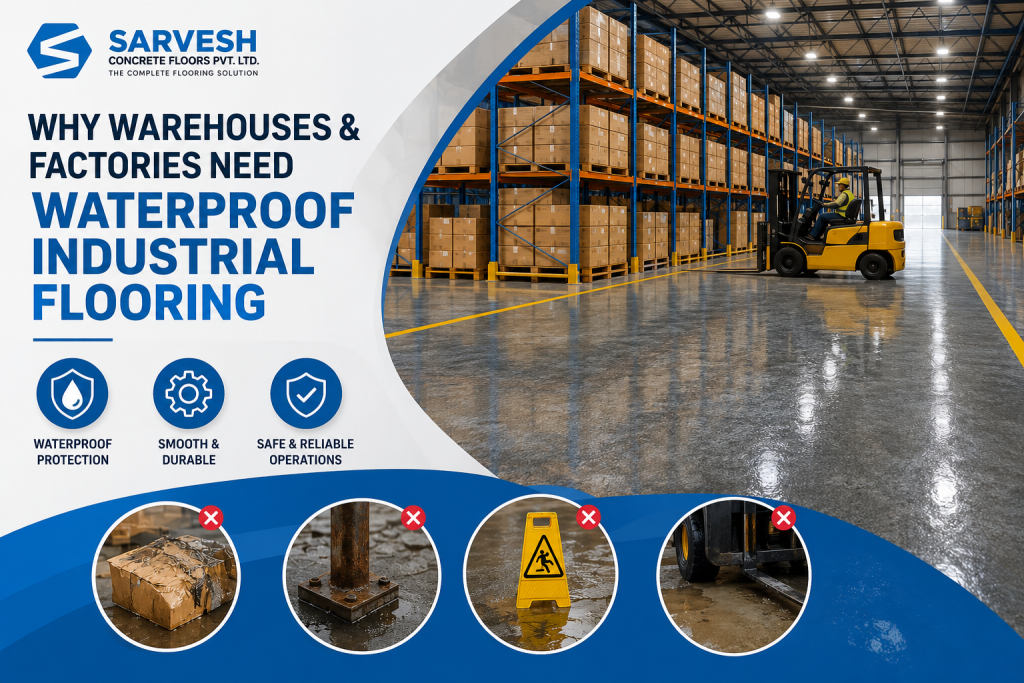
What’s Really at Stake When Floors Aren’t Waterproofed For most factories and warehouses, the floor isn’t just a surface   it’s where inventory sits, where machinery operates, and where workers and vehicles move all day. When water gets in, the damage isn’t limited to the floor itself. Moisture-sensitive inventory (paper products, packaging, textiles, electronics) can be ruined within hours of exposure. Metal shelving, machine bases, and equipment legs are prone to rusting when floors stay damp. And wet concrete becomes dangerously slippery for forklifts and foot traffic, increasing the risk of workplace accidents  a serious liability concern for any facility manager. Common Scenarios Where This Goes Wrong Loading dock areas are especially vulnerable since they’re directly exposed to open bays where rain blows in during monsoon. Many warehouses in industrial belts like Bhiwandi, Taloja, and Navi Mumbai also sit on land with high groundwater tables, meaning even ground-floor slabs can experience seepage from below. Older factory buildings that were constructed before waterproofing became a standard part of industrial construction often rely on basic RCC flooring with no additional protective layer — these are the floors most likely to develop cracks, dust, and water damage over just a few monsoon cycles. What a Properly Built Monsoon-Ready Floor Looks Like A well-designed industrial floor for Mumbai’s climate typically starts with a strong base like Vacuum Dewatered Flooring (VDF), which is denser and less porous than standard concrete. On top of this, a waterproof epoxy or PU coating seals the surface completely, making it resistant to water, oil, and chemical spills common in industrial settings. Just as critical is the drainage design  proper slope gradients and channel drains built into the floor plan ensure water is directed away from storage and work areas instead of pooling. The Business Case: Why This Isn’t Just a Maintenance Expense Business owners sometimes view flooring upgrades as a cosmetic or optional expense, but for warehouses and factories, it directly affects three things that matter to the bottom line: inventory protection, worker safety compliance, and operational uptime. A single incident of water damage to stored goods, or a workplace injury from a slippery floor, often costs significantly more than the price of proper waterproof flooring  not to mention potential insurance and liability complications. Frequently Asked Questions Can existing industrial flooring be waterproofed without shutting down operations? Yes, in most cases work can be phased section-by-section to minimize disruption to ongoing operations. Is VDF flooring necessary, or can waterproof coating alone work? For heavy machinery or vehicle traffic, VDF as a base plus a waterproof topcoat gives the best long-term durability. For lighter-use spaces, a strong waterproof coating on existing concrete can suffice. How long does waterproof industrial flooring typically last? With proper installation and maintenance, it commonly lasts 8-15 years depending on usage intensity and exposure conditions. Ready to Get Started? Talk to Sarvesh Concrete Floors about a waterproof flooring solution designed for your warehouse or factory’s specific operational needs.

Modern Parking Flooring Solutions for High Rise Buildings in Mumbai
Concrete Flooring

Modern Parking Flooring Solutions for High-Rise Buildings in Mumbai

Mumbai’s skyline is growing vertically — but so are its parking challenges. Today’s residential towers, commercial complexes, and mixed-use developments depend heavily on multi-level basements, stilts, and podium parking decks. These areas face far harsher conditions than normal floors: water seepage, tyre abrasion, oil spills, coastal humidity, and constant vehicle movement. Traditional flooring methods like plain concrete or tiles simply cannot survive long in such an environment. This blog explains the modern parking flooring technologies that high-rise buildings in Mumbai are adopting — and why advanced coating systems like PU, epoxy, and hybrid parking deck systems have become essential rather than optional. Modern Parking Flooring Solutions for High-Rise Buildings in Mumbai Mumbai is one of the toughest cities in the world for concrete structures. Monsoon Water Exposure Heavy rainfall leads to: Water ponding Leakage into basements Damp walls & efflorescence Prolonged moisture exposure allows water and chlorides to penetrate concrete, eventually weakening reinforcement steel. Coastal Humidity & Salt Attack Salt carried inland from the sea accelerates corrosion in reinforced concrete — especially in parking garages and exposed decks. Structural Movement in High-Rise Buildings Parking decks are wide span slabs with minimal columns. They constantly move due to: Thermal expansion Traffic vibration Load changes This leads to cracking and early concrete failure if rigid flooring is used. Heavy Mechanical Wear Parking floors experience: Turning tyre stress Oil & brake fluid spills Abrasion from traffic Bare concrete starts dusting and potholing within 1–3 years. 2. The Shift From Traditional Flooring to Engineered Parking Systems Old Method Problems Plain concrete Dusting & cracks China mosaic / tiles Breakage & water leakage Pavers Settlement & maintenance IPS flooring Weak & porous 3. Modern Parking Flooring Solutions (Used in Premium Projects) Polyurethane (PU) Car Parking Flooring — The New Standard Best for: Podium, ramps, terraces, open parking decks PU coatings form a seamless waterproof membrane over concrete, preventing water ingress. Key Advantages Waterproof + flooring in one system Crack-bridging elasticity (handles slab movement) UV resistant (no yellowing) Anti-skid finish for ramps Oil & chemical resistant Ideal for exposed areas PU flooring flexes with temperature changes, reducing cracks compared to rigid coatings. Because of its flexibility, it performs well in high-traffic parking structures and under impact loads. Epoxy Flooring — For Basement Parking Best for: Fully covered basement parking Epoxy provides: Very high hardness Smooth dust-free finish Chemical resistance Easy cleaning However, epoxy is rigid and does not handle structural movement well. 👉 Therefore: Basement → Epoxy works well Podium/Open → Not recommended alone PU + Epoxy Hybrid Systems (Most Popular Today) Used in premium high-rise projects: Area Recommended System Basement parking Epoxy coating Podium deck PU waterproof traffic coating Ramps Heavy duty PU anti-skid Driveways PU or PU-concrete Visitor areas Decorative coatings This gives durability + waterproofing + aesthetics. Cementitious Urethane / PU Concrete Best for: Entry/exit ramps Commercial complexes Malls These systems repair and coat simultaneously while handling temperature changes and heavy traffic. 4. Functional Features in Modern Parking Floors Modern parking flooring is no longer just grey cement — it’s engineered infrastructure. Safety Features Anti-skid ramps Pedestrian walkways Glow markings Reflective arrows Operational Features Colour zoning Parking bay numbering EV charging areas Fire lane marking Structural Protection Waterproofing membrane Crack bridging Chloride protection Abrasion resistance 5. Benefits for Builders & Societies For Builders Faster project handover Premium project positioning Reduced waterproofing complaints For Societies Zero leakage into basement No dust or potholes Easy cleaning & maintenance Long life (10–15+ years) PU systems can significantly reduce long-term maintenance costs because they combine flooring and waterproofing in one layer. 6. Future Trends in Mumbai Parking Flooring The next generation of parking areas will include: EV charging resistant coatings Smart reflective parking layouts Noise-reduction floors Sustainable low-VOC coatings Decorative premium podium decks Parking is evolving from a utility space to a lifestyle amenity. Conclusion High-rise buildings in Mumbai demand more than ordinary flooring. With monsoon exposure, coastal corrosion, and heavy traffic, traditional concrete parking fails quickly. Modern developments now rely on engineered systems: Basement → Epoxy Podium → PU Waterproof Deck System Ramps → Anti-Skid PU Driveways → Heavy-duty urethane In today’s construction environment, parking flooring is no longer finishing work — it is structural protection. Choosing the right parking flooring solution doesn’t just improve appearance… It protects the entire building.

Scroll to Top