
Modern residential and commercial buildings depend heavily on basements, stilts, and podium areas for parking. But one of the most common complaints from housing societies, builders, and facility managers is:
Car Parking Mein Seepage Aa Raha Hai
Water dripping from slab soffits, peeling paint, damp columns, fungus growth, and damaged vehicles — these are not just cosmetic issues; they indicate structural distress.
This blog explains:
- Why parking waterproofing fails
- What damage it causes
- And how PU (Polyurethane) coating permanently solves the problem
1. Why Car Parking Waterproofing Fails
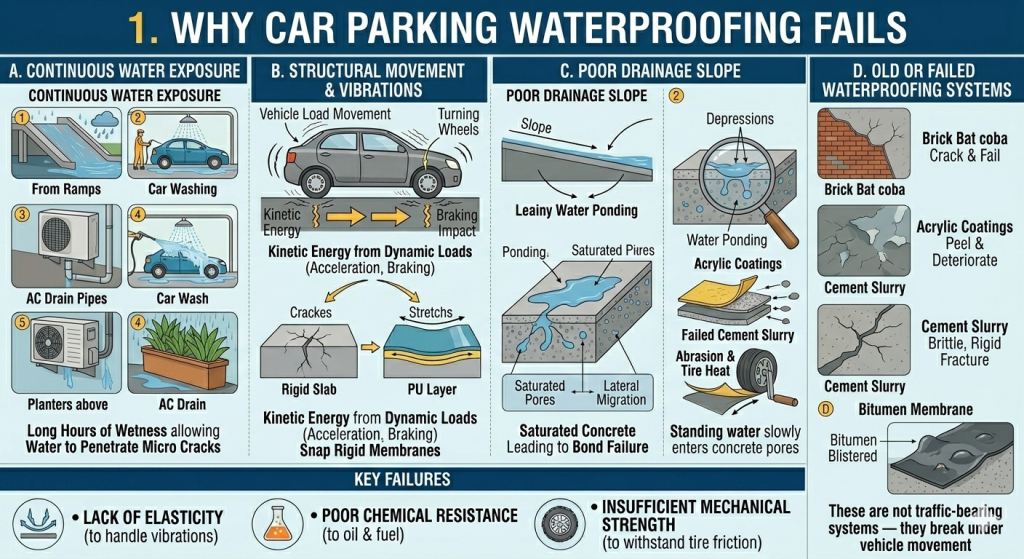
Parking slabs face extreme conditions every day that normal terrace waterproofing cannot handle.

A. Continuous Water Exposure
Sources of water:
- Rainwater from ramps
- Car washing
- AC drain pipes
- Planters above podium
- Plumbing leakages
- Cleaning water
Unlike terraces, parking areas stay wet for long hours, allowing water to penetrate micro cracks.
B. Structural Movement & Vibrations
Car parking slabs constantly vibrate due to:
- Vehicle load movement
- Turning wheels
- Braking impact
- Temperature expansion & contraction
Rigid waterproofing systems crack within months.
C. Poor Drainage Slope
Many parking floors have:
- Negative slope
- Depressions
- Water ponding
Standing water slowly enters the concrete pores.
D. Old or Failed Waterproofing Systems
Commonly used systems that fail:
- Brick bat coba
- IPS flooring
- Cement slurry coating
- Acrylic coatings
- Bitumen membranes
These are not traffic-bearing systems — they break under vehicle movement.
2. What Damage Seepage Causes
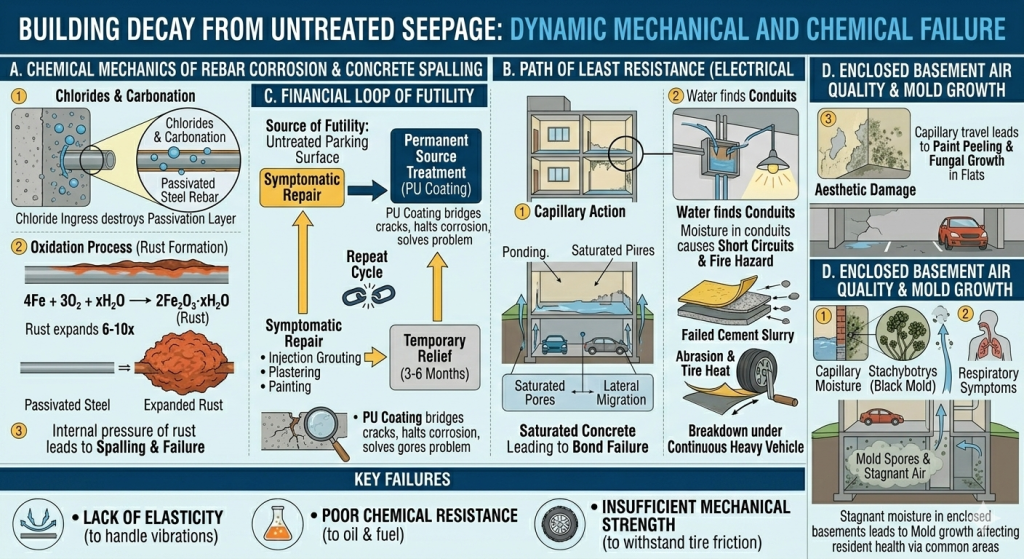
Parking leakage is not just a surface problem. It spreads through the building.
Structural Damage
- Steel reinforcement corrosion
- Concrete spalling
- Reduced slab strength
- Cracks in beams & columns
Aesthetic Damage
- Paint peeling in lower floors
- Damp patches in flats
- Fungal growth & odor
Electrical Risk
- Water enters conduits
- Short circuits in basement lighting
- Fire hazard
Financial Loss
Societies repeatedly spend money on:
- Repainting
- Patch repairs
- Injection grouting (temporary)
- Ceiling plaster replacement
But the leakage returns because the root cause — the parking surface — is untreated.
3. Why Traditional Waterproofing Doesn’t Work in Parking
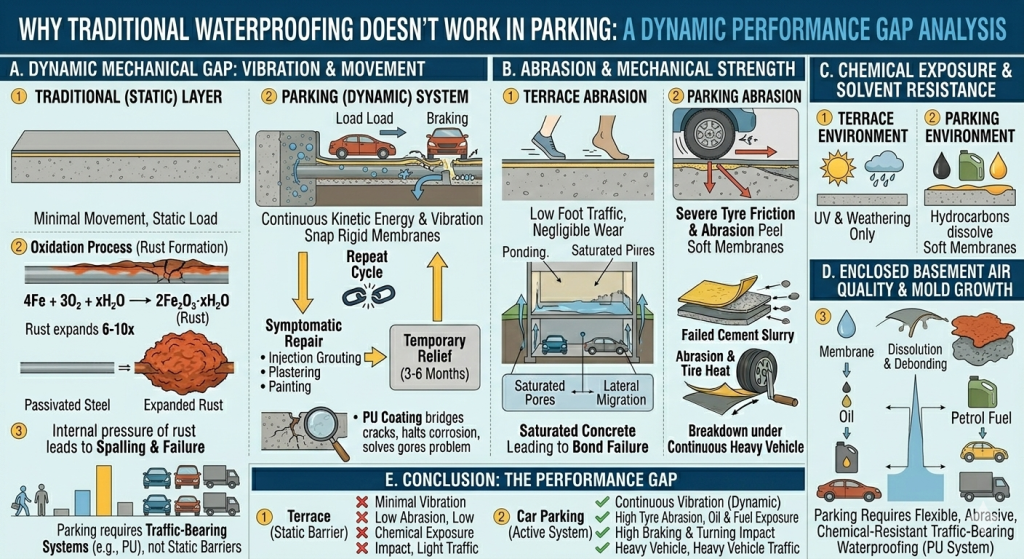
Parking is not a terrace.
| Requirement | Terrace | Car Parking |
| Foot Traffic | Low | Heavy Vehicle |
| Movement | Minimal | Continuous vibration |
| Abrasion | Low | Tyre friction |
| Chemical Exposure | None | Oil & fuel |
| Impact | No | Braking & turning |
Conclusion:
Parking requires a traffic-bearing waterproofing system, not a conventional waterproof layer.
4. The Real Solution — PU Coating System
Polyurethane (PU) car parking coating is both:
Waterproofing + Flooring Protection
It creates a seamless elastic membrane bonded permanently with concrete.
5. How PU Coating Works
PU coating penetrates into concrete pores and forms a flexible rubber-like layer.
Key Mechanism
- Penetrates micro cracks
- Bonds chemically with concrete
- Forms elastic membrane
- Absorbs movement
- Prevents water ingress
Even if concrete develops hairline cracks later, PU stretches instead of breaking.
6. Complete PU Car Parking System Layers
Step 1 — Surface Preparation
- Grinding with diamond machine
- Removal of laitance & weak concrete
- Crack treatment
This is the most critical stage (70% success depends here).
Step 2 — Primer
Low viscosity PU primer:
- Penetrates pores
- Strengthens substrate
- Improves adhesion
Step 3 — PU Base Waterproofing Coat
High elasticity membrane:
- Crack bridging up to 2 mm
- Permanent waterproof barrier
Step 4 — Broadcast Quartz / Silica
Provides:
- Anti-skid surface
- Mechanical strength
Step 5 — PU Top Coat
UV resistant & abrasion resistant finish:
- Traffic bearing
- Oil resistant
- Easy to clean
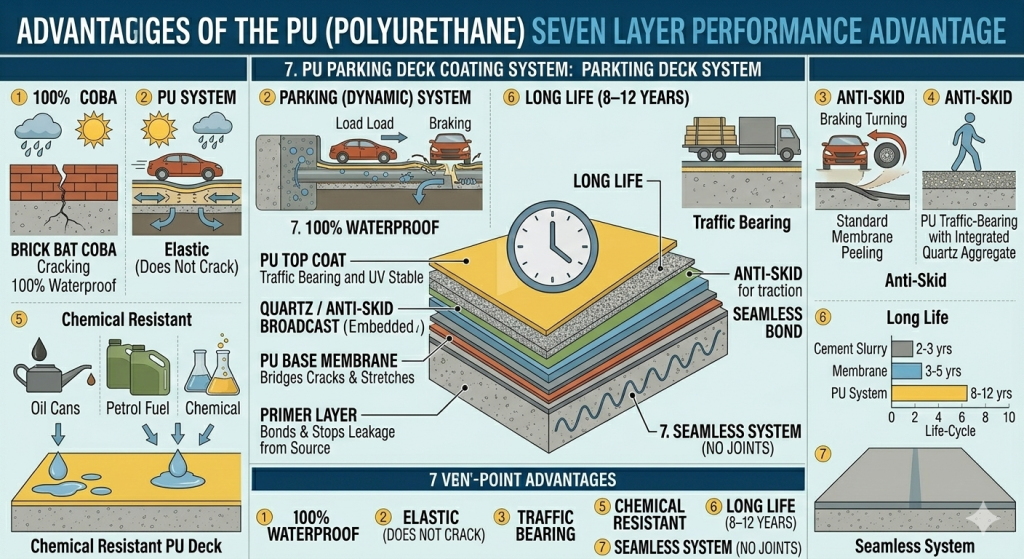
7. Advantages of PU Coating in Car Parking
100% Waterproof
Stops leakage from source — slab top.
Elastic (Does Not Crack)
Handles structural movement.
Traffic Bearing
Designed for continuous vehicle use.
Anti-Skid
Safe for pedestrians & vehicles.
Chemical Resistant
Resists oil, petrol & grease.
Long Life
8–12 years performance when applied correctly.
Seamless System
No joints = no leakage path.
8. Where PU Coating Is Required
- Basement parking
- Stilt parking
- Podium parking
- Ramp areas
- Driveways
- Mechanical parking zones
- Wash areas
9. Common Mistakes to Avoid
- Applying epoxy instead of PU (epoxy cracks in movement areas)
- Doing injection grouting repeatedly
- Ignoring slope correction
- Applying coating on wet concrete
- Hiring painters instead of flooring specialists
10. Signs Your Parking Needs PU Waterproofing
You should act immediately if you see:
- Water dripping from ceiling
- Damp patches in lower flats
- White salt deposits (efflorescence)
- Concrete pieces falling
- Rust marks
- Fungus smell in basement
These indicate active slab seepage.
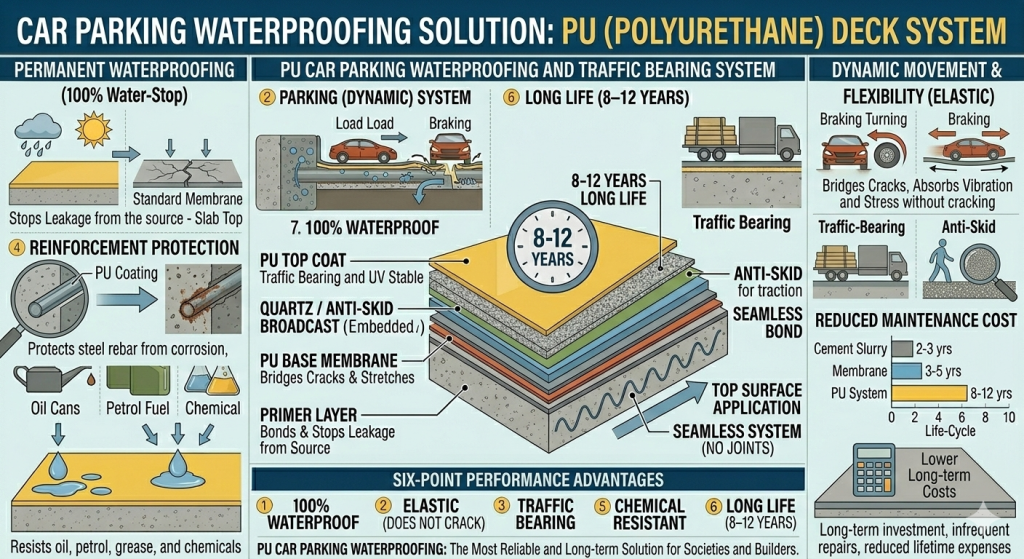
11. Long-Term Cost Comparison
| Method | Life | Repetition | Actual Cost |
| Cement coating | 6 months | Repeated | Very High |
| Injection grouting | Temporary | Frequent | Very High |
| Membrane sheet | 2–3 years | Replacement | High |
| PU Coating | 8–12 years | One-time | Lowest |
Conclusion
Car parking leakage never stops until the waterproofing is done from the top surface using a flexible traffic-bearing system.
PU coating is not just a coating —
it is a structural protection system that:
- Stops seepage permanently
- Protects reinforcement
- Improves safety
- Reduces maintenance cost
For societies and builders facing continuous parking leakage complaints,
PU car parking waterproofing is the most reliable and long-term solution available today.