
Commercial car parking floors face continuous tyre traffic, turning forces, oil stains, water, dirt, ramps, drainage and frequent cleaning. In podiums and multi-level car parks, the floor may also sit over occupied spaces and therefore needs to work with waterproofing and crack movement. This is why the choice between PU and epoxy flooring should be based on where the parking area is located and what performance the deck requires not simply on which material is more popular.
Epoxy and polyurethane are both proven resin technologies, but they behave differently. Epoxy systems are generally rigid, hard and highly suitable for protected indoor concrete where an abrasion-resistant finish is required. PU-based car-park systems can provide greater flexibility, crack-bridging and UV/weather resistance when designed for suspended, exposed or movement-prone decks. Some car-park specifications intentionally combine epoxy primers with polyurethane wearing or waterproofing layers, so the best answer can also be a hybrid system.
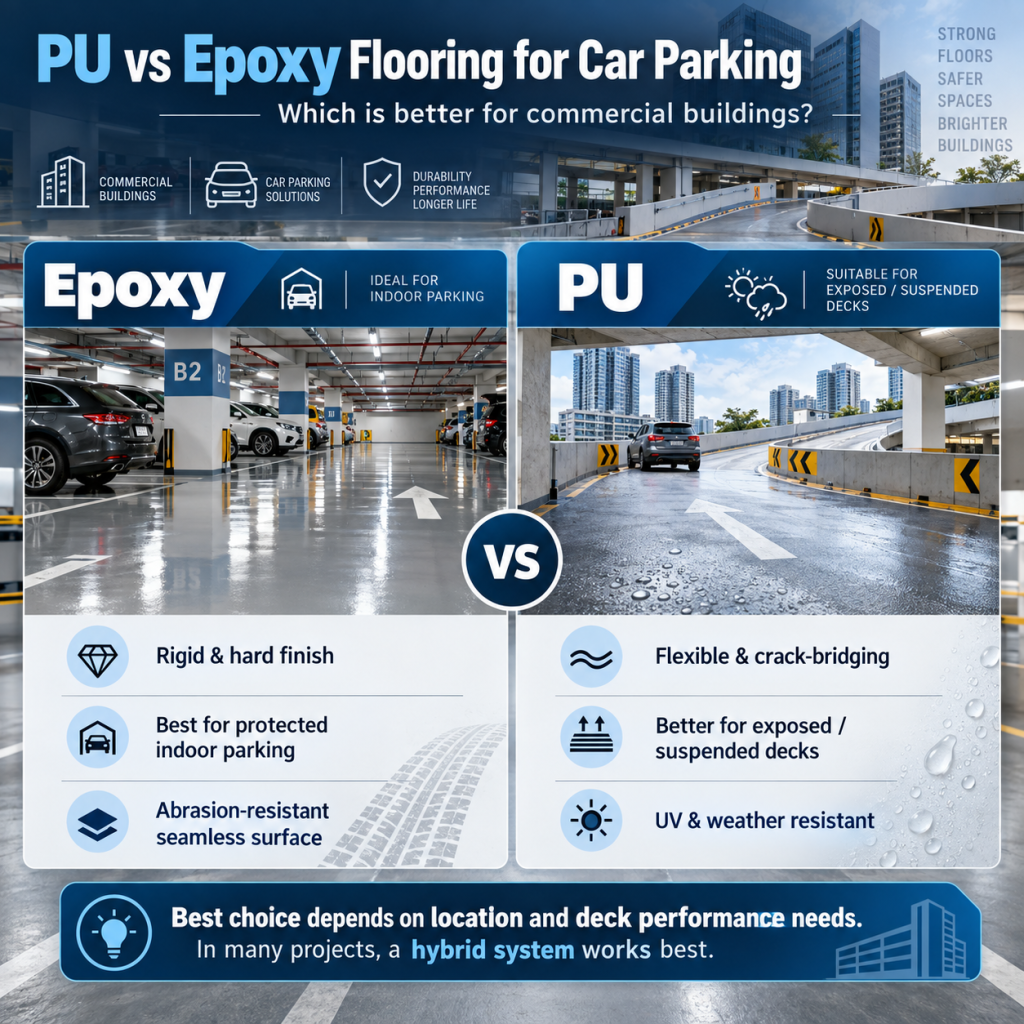
What Is Epoxy Flooring for Car Parking?
Epoxy flooring is created by combining an epoxy resin with a hardener to form a strong bonded surface over prepared concrete. Car-parking epoxy systems may use primers, body coats, broadcast aggregates and topcoats to achieve the required thickness and slip resistance. Epoxy is especially useful in protected indoor locations where the concrete is stable and the main requirements are wear resistance, cleanliness, colour zoning and easy maintenance.
Key Advantages of Epoxy Parking Floors
- Hard, seamless surface with good resistance to routine tyre and pedestrian traffic when correctly specified.
- Good adhesion to mechanically prepared concrete.
- Easy-to-clean finish compared with dusty bare concrete.
- Can incorporate broadcast aggregate for slip resistance on drive lanes and ramps.
- Useful for colour coding bays, pedestrian paths, arrows and different parking zones.
- Available in different build-ups for light to higher-duty internal parking applications.
What Is PU Flooring for Car Parking?
Polyurethane car-parking systems are typically more elastic than rigid epoxy coatings and can be designed to accommodate movement, bridge cracks and resist UV exposure. Dedicated PU deck systems are widely used on intermediate and exposed parking decks where waterproofing, flexibility and weather resistance are important. Depending on the system, a PU floor may include a primer, elastic membrane, wearing layer, aggregate broadcast and UV-stable topcoat.
Key Advantages of PU Parking Floors
- Greater flexibility and crack-bridging capability in suitable deck systems.
- Waterproofing options for suspended podiums and decks over occupied areas.
- UV-stable and weather-resistant topcoat options for exposed parking areas.
- Good mechanical and abrasion performance in properly designed car-park systems.
- Slip-resistant textured finishes can be created with broadcast aggregate.
- Useful on ramps, podiums and dynamic deck areas where movement must be considered.
PU vs Epoxy Flooring: Main Differences
| Factor | Epoxy Flooring | PU Flooring / Deck System |
|---|---|---|
| Rigidity / flexibility | Generally more rigid and hard | Generally more flexible; some systems designed for crack bridging |
| Best environment | Protected indoor / stable concrete | Podiums, suspended decks, ramps and exposed areas when suitably specified |
| UV exposure | Standard epoxy may yellow/chalk without suitable UV-stable finish | UV-stable PU/topcoat systems are available for exposed decks |
| Waterproofing | Can be impermeable but not every epoxy floor is a waterproof deck membrane | Dedicated PU systems can include elastic waterproofing membranes |
| Slip resistance | Broadcast aggregate can create anti-skid texture | Broadcast aggregate can create anti-skid texture |
| Mechanical wear | Good to high depending on build-up | Good to high depending on car-park system |
| Crack movement | Rigid systems have limited movement accommodation | Elastic systems can provide greater crack-bridging capability |
| Maintenance | Seamless and cleanable | Seamless and cleanable; topcoat may be renewed as part of maintenance |
Which Is Better for Basement Car Parking?
For a dry, protected basement on a stable slab, epoxy can be an efficient and durable solution. It provides a clean finish, improves light reflection, supports colour zoning and is easy to maintain. A textured epoxy broadcast system can also improve traction on drive lanes.
However, basements often have moisture challenges. Before installing epoxy, the substrate should be tested and any water ingress or vapour problem should be addressed. If the basement structure requires waterproofing or the deck has significant movement, a different membrane or flexible system may be needed beneath or instead of a conventional epoxy coating.
Which Is Better for Podium and Intermediate Deck Parking?
Podium and suspended intermediate decks behave differently from ground-bearing slabs because they can experience structural movement and may be located over occupied spaces. In these situations, elastic PU or hybrid car-park deck systems are often preferred where crack bridging and waterproofing are part of the specification. Dedicated systems can combine an epoxy primer with PU membrane and wearing layers to achieve both adhesion and flexibility.
Which Is Better for Exposed Top Deck Parking?
Exposed parking decks must deal with sunlight, rain, temperature changes and traffic at the same time. A UV-stable, crack-bridging and waterproof car-park system is generally more appropriate than a standard indoor epoxy finish. PU, polyaspartic or hybrid deck systems are commonly designed for these conditions. The exact system should be selected for local climate, deck movement and drainage requirements.
What About Car Parking Ramps?
Ramps experience braking, acceleration and turning forces that are more aggressive than normal parking bays. The surface should therefore be designed for high wear and slip resistance. Both epoxy and PU technologies can be used in ramp systems when they include the correct broadcast aggregate and wear layer, but movement, UV exposure and waterproofing needs should guide the final chemistry.
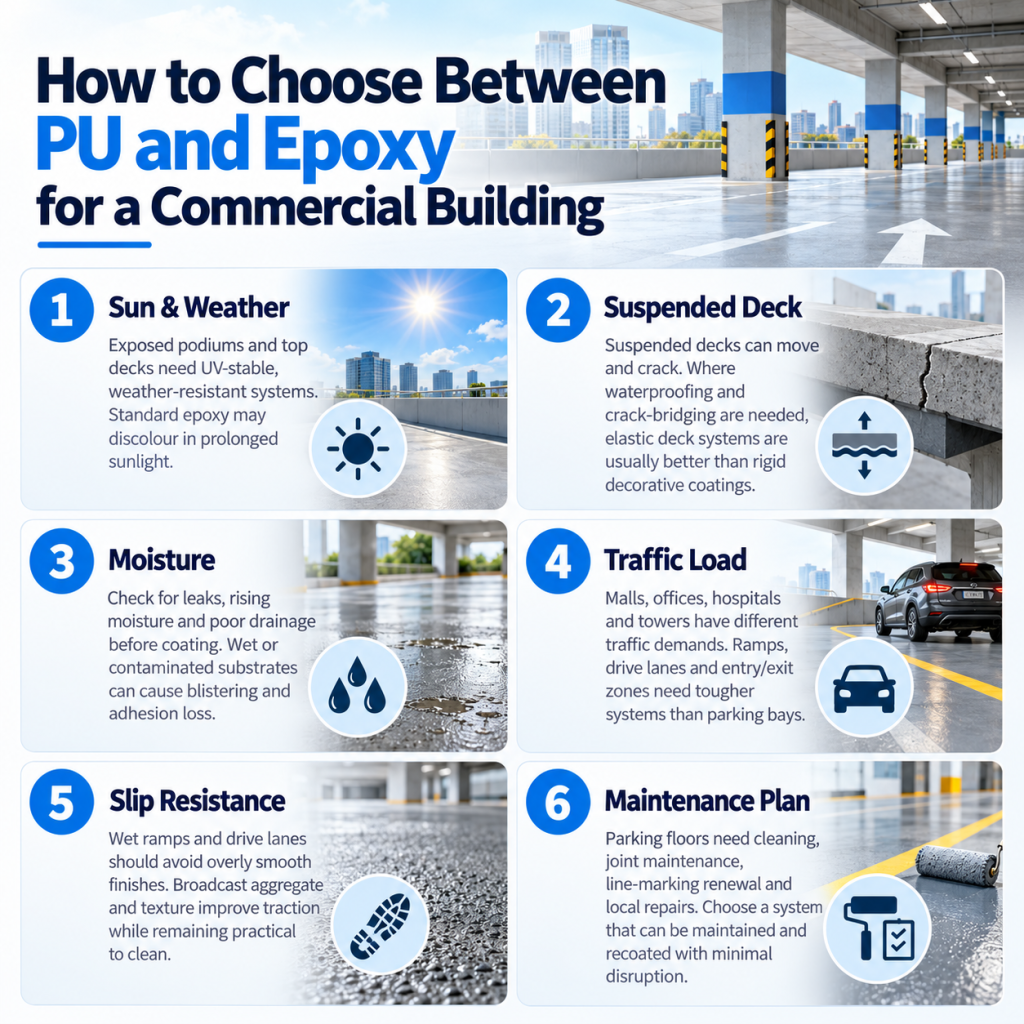
How to Choose Between PU and Epoxy for a Commercial Building
1. Is the Area Exposed to Sun and Weather?
For exposed podiums and top decks, specify a system with confirmed UV stability and weather resistance. Standard epoxy without a UV-stable protective finish may change colour under prolonged sunlight.
2. Is the Deck Suspended?
Suspended decks can move and crack. If waterproofing and crack bridging are required, an elastic deck system is usually more suitable than a rigid decorative coating.
3. Is Moisture Present?
Identify leaks, rising moisture and drainage problems before coating. Coating over a wet or contaminated substrate can lead to blistering or adhesion loss.
4. How Heavy Is the Traffic?
Shopping malls, offices, hospitals and commercial towers may have very different vehicle volumes. Drive lanes, entry/exit zones and ramps often need a heavier wearing system than individual parking bays.
5. Is Slip Resistance Required?
Wet ramps and drive lanes should not use an overly smooth decorative finish. Broadcast aggregate and texture can improve traction, but the profile should still be practical to clean.
6. What Is the Maintenance Plan?
Parking floors need periodic cleaning, joint maintenance, line-marking renewal and local repairs. Choose a system that can be maintained and recoated without unnecessary disruption to the building.
Best Choice by Parking Location
| Parking Zone | Often Suitable | Reason |
|---|---|---|
| Protected basement | Epoxy or suitable PU system | Stable indoor slab; cleanability and abrasion are key |
| Intermediate suspended deck | Elastic PU / hybrid deck system | Movement, waterproofing and crack bridging may be required |
| Podium over occupied area | Waterproof elastic PU / hybrid system | Protects spaces below while carrying traffic |
| Exposed top deck | UV-stable PU / polyaspartic / hybrid deck system | Sun, rain, temperature and movement exposure |
| Ramp | Heavy-duty broadcast epoxy or PU system | High shear, braking and slip-resistance demand |
| Parking bay / pedestrian zone | Epoxy or PU depending overall deck design | Lower wear than ramps; colour zoning and cleanability important |
PU vs Epoxy: Which One Should You Choose?
For protected commercial basement parking with a stable, dry concrete slab, epoxy is often a practical choice because it provides a hard, seamless and cleanable finish. For podiums, suspended decks, ramps or exposed parking where waterproofing, crack movement and UV resistance are important, a PU-based or hybrid car-park system is often the stronger technical direction.
The decision should be made by area rather than by brand name alone. Large commercial buildings may use one system in the basement, another on the podium and a higher-duty UV-stable system on ramps or exposed decks. A site inspection can identify substrate condition, moisture, cracks, drainage and traffic patterns before the final specification is prepared.
Frequently Asked Questions
PU is often preferred where flexibility, crack bridging, waterproofing or UV exposure are important. Epoxy is often an excellent choice for protected internal parking on stable concrete. The parking location and performance requirements should determine the system.
Yes, when the epoxy system is designed for vehicular traffic and includes an appropriate anti-skid aggregate and wearing layer. Ramps are high-wear zones, so a simple smooth coating is usually not the best specification.
For suspended podiums, an elastic waterproof car-park deck system is often advantageous because it can accommodate movement and protect areas below. PU or hybrid systems are commonly used for this purpose, subject to project specifications.
Standard epoxy can yellow or change appearance under prolonged UV exposure. Exposed car parks should use a system with confirmed UV-stable topcoats or a resin technology designed for outdoor exposure.
Certain dedicated PU car-park deck systems include waterproof elastic membranes, but not every product labelled “PU flooring” is automatically a waterproofing system. The complete tested system and layer build-up should be specified.
Look for experience with basement, stilt, podium and ramp applications; proper surface preparation; moisture and crack assessment; system-specific technical data; traffic planning; line marking; and a clear maintenance approach rather than selecting only on price per square foot.