
Choosing epoxy flooring is not only about colour, gloss or price. One of the most important decisions is the thickness of the flooring system. A floor that is too light for the actual operating conditions can wear prematurely, while an unnecessarily heavy system may increase project cost without adding useful performance. For factories, warehouses, workshops, commercial buildings and car parking areas, the right epoxy flooring thickness should be selected according to how the floor will actually be used.
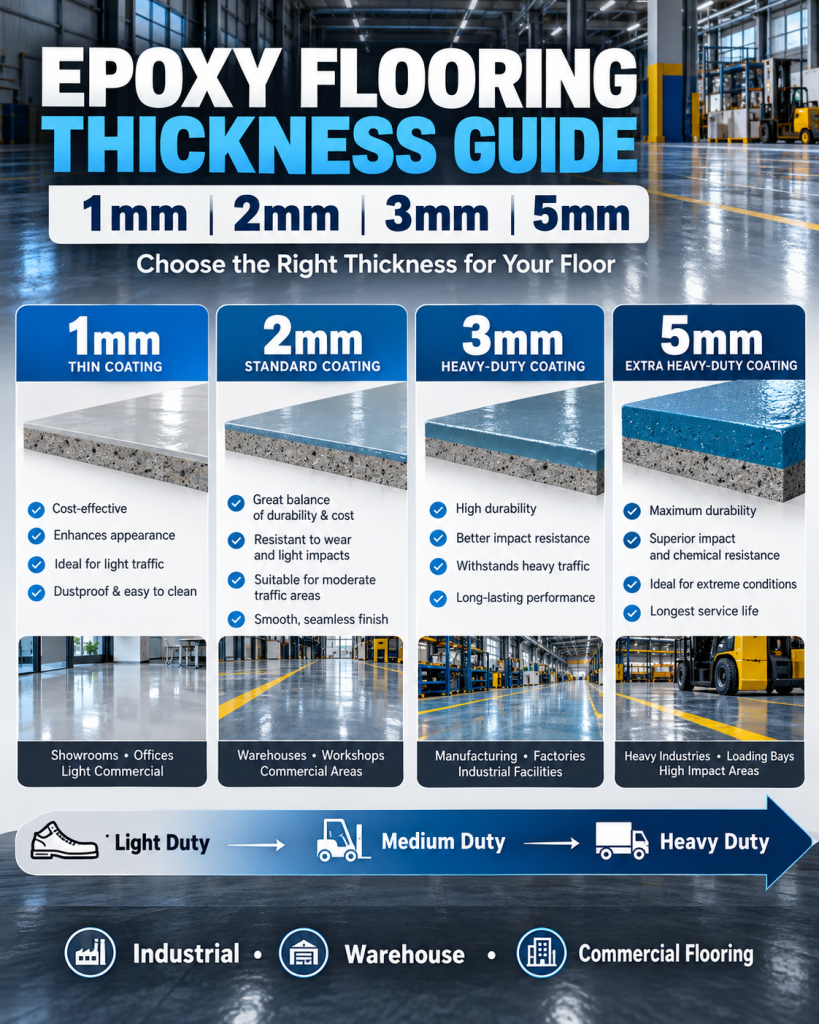
Epoxy systems are available in different build-ups, from relatively thin protective coatings to self-smoothing and broadcast systems several millimetres thick. Manufacturer data for industrial systems commonly spans approximately 1–2 mm for some coating systems, 2–4 mm for self-smoothing systems, and thicker broadcast or heavy-duty systems that can reach around 4–6 mm. The practical choice should therefore be made after evaluating traffic, loading, substrate quality and exposure conditions.
Why Epoxy Flooring Thickness Matters
Thickness influences how the finished flooring system responds to wear, abrasion, impact and repeated traffic. It can also affect how well the system hides minor surface imperfections and how much material is available as a wearing layer over the concrete base. However, thickness works together with resin quality, aggregate, surface preparation, primer selection, curing and workmanship. A poorly prepared 5 mm system can fail earlier than a correctly prepared thinner system.
- Wear resistance: higher-duty areas generally need a system designed with a stronger wearing layer, not simply an extra coat of resin.
- Impact and point loads: workshops and production areas may experience dropped tools, trolley wheels, pallet movement and localised mechanical stress.
- Chemical exposure: oils, cleaning agents, process chemicals and automotive fluids may require a specific resin chemistry and topcoat.
- Surface profile: rough, porous or damaged concrete usually needs repairs and levelling before the final epoxy system can perform properly.
- Slip resistance: ramps, wet zones and production floors may need a broadcast aggregate system rather than a smooth finish.
What Does 1mm Epoxy Flooring Mean?
A 1 mm epoxy flooring system is at the lighter end of industrial resin flooring. Depending on the product and specification, it may be used where the main requirement is seamless protection, improved cleanability, colour coding and moderate wear resistance. Some commercial epoxy systems are specifically designed to work in the 1–2 mm range.
Where 1mm Epoxy Flooring Can Be Suitable
- Utility rooms, service corridors and controlled indoor areas with relatively light mechanical traffic.
- Commercial spaces where cleanliness and a seamless finish are more important than heavy impact resistance.
- Selected production or storage areas with light foot and trolley traffic, subject to the chosen product specification.
- Refurbishment projects where the substrate is already sound, level and properly prepared.
A 1mm system should not be selected only because it has a lower initial cost. If the floor is exposed to frequent forklifts, heavy pallet movement, repeated impact or aggressive chemicals, a higher-duty system may offer better lifecycle value.
What Does 2mm Epoxy Flooring Mean?
Around 2mm is a common design range for self-smoothing or high-build industrial epoxy systems. It can provide a balance between finish quality, cleanability and mechanical performance for many indoor commercial and industrial applications. Product-specific data sheets should be checked because some systems are designed for a 1–2 mm build, while others start at approximately 2 mm.
Typical Applications for 2mm Epoxy Flooring
- Light-to-medium industrial production areas.
- Warehouses with moderate material-handling traffic.
- Workshops and maintenance rooms with controlled mechanical loads.
- Pharma, healthcare or food-related support areas where , easy-to-clean surface is needed, subject to hygiene and chemical requirements.
- Indoor commercial floors where appearance and durability are both important.
What Does 3mm Epoxy Flooring Mean?
A 3mm epoxy system provides a more substantial wearing layer and is often considered for environments with higher traffic and stronger mechanical demands. Industrial flooring systems in the 2–3 mm or 2–4 mm range are commonly available for warehouses and production areas. At this duty level, the specification should consider not only thickness but also abrasion resistance, compressive performance, aggregate grading and the type of traffic wheels operating on the floor.
Where 3mm Epoxy Flooring May Be Appropriate
- Busy warehouses with regular pallet trucks or forklifts.
- Manufacturing and assembly areas with repeated wheeled traffic.
- Commercial back-of-house spaces exposed to heavier daily use.
- Industrial corridors, dispatch areas and selected loading-support zones.
- Areas requiring a more robust self-smoothing or broadcast finish than a light coating can provide.
For forklift routes, turning zones and dock approaches, the wheel type and traffic intensity matter greatly. Hard small wheels can create concentrated stress and abrasion, so these areas may need a broadcast system, resin mortar or a heavy-duty concrete solution rather than a smooth self-levelling epoxy alone.
What Does 5mm Epoxy Flooring Mean?
At approximately 5mm, the flooring is generally moving into a heavier-duty resin build-up such as a broadcast, filled or resin-mortar system rather than a simple roller-applied coating. Manufacturer systems exist in the 4–6 mm range for environments requiring higher wear resistance, texture or more substantial protection.
Applications Where a 5mm System May Be Considered
- Heavy industrial traffic zones with repeated abrasion and impact.
- Workshop areas where tools, components or materials may be dropped.
- Loading, dispatch or turning zones with demanding wheeled traffic.
- Selected car parking ramps or high-wear areas when the specified system is designed for vehicular use and slip resistance.
- Industrial locations where a resin mortar or broadcast system is required to build a tougher wearing surface.
Even at 5mm, epoxy is still a surface system over a concrete substrate. It cannot compensate for an under-designed structural slab, uncontrolled movement, major settlement or serious moisture problems. Structural and substrate issues should be addressed before coating.
1mm vs 2mm vs 3mm vs 5mm Epoxy Flooring
| Thickness | Typical Duty | Common Use Cases | Key Consideration |
|---|---|---|---|
| 1 mm | Light / Selected Medium Duty | Utility, commercial and clean indoor areas | Requires a sound, well-prepared substrate and suitable product |
| 2 mm | Medium Duty | Production, storage, workshops and commercial floors | Good balance of finish and durability for many indoor areas |
| 3 mm | Medium-Heavy Duty | Warehouses, manufacturing and regular MHE routes | Traffic wheels, turning and abrasion should be assessed |
| 5 mm | Heavy-Duty Resin Build-Up | High-wear industrial areas, impact zones and selected ramps | Usually a broadcast, filled or mortar system—not simply more topcoat |
How to Choose the Right Epoxy Flooring Thickness
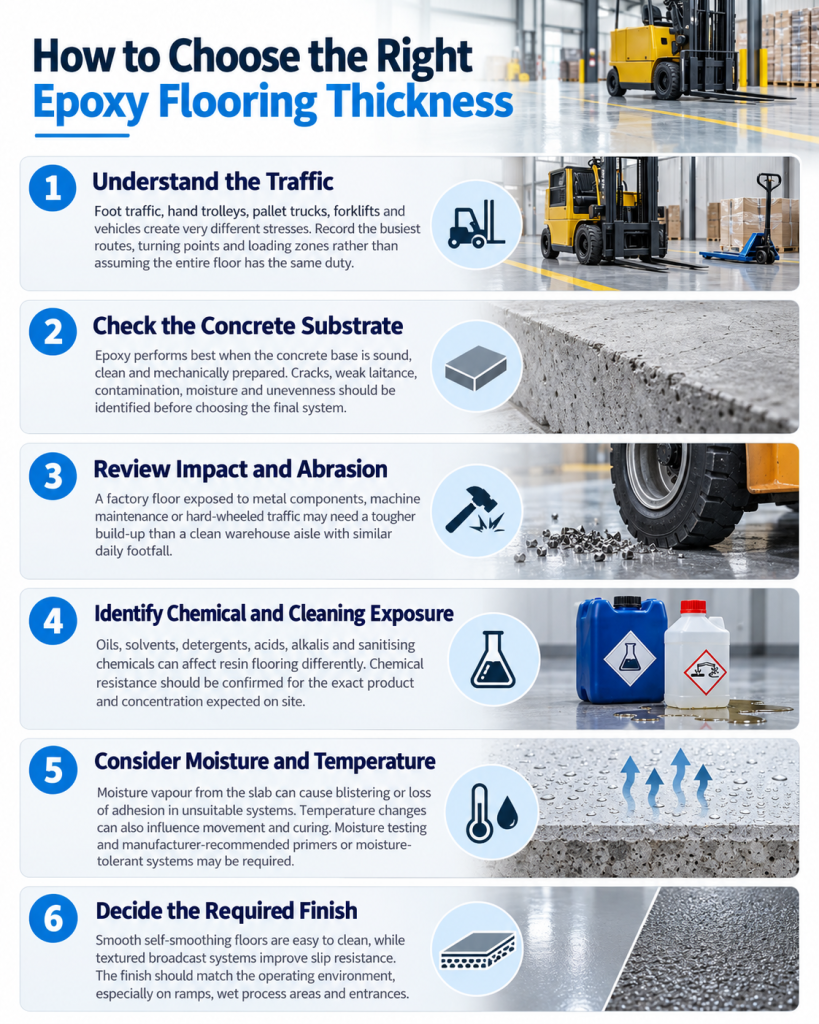
1. Understand the Traffic
Foot traffic, hand trolleys, pallet trucks, forklifts and vehicles create very different stresses. Record the busiest routes, turning points and loading zones rather than assuming the entire floor has the same duty.
2. Check the Concrete Substrate
Epoxy performs best when the concrete base is sound, clean and mechanically prepared. Cracks, weak laitance, contamination, moisture and unevenness should be identified before choosing the final system.
3. Review Impact and Abrasion
A factory floor exposed to metal components, machine maintenance or hard-wheeled traffic may need a tougher build-up than a clean warehouse aisle with similar daily footfall.
4. Identify Chemical and Cleaning Exposure
Oils, solvents, detergents, acids, alkalis and sanitising chemicals can affect resin flooring differently. Chemical resistance should be confirmed for the exact product and concentration expected on site.
5. Consider Moisture and Temperature
Moisture vapour from the slab can cause blistering or loss of adhesion in unsuitable systems. Temperature changes can also influence movement and curing. Moisture testing and manufacturer-recommended primers or moisture-tolerant systems may be required.
6. Decide the Required Finish
Smooth self-smoothing floors are easy to clean, while textured broadcast systems improve slip resistance. The finish should match the operating environment, especially on ramps, wet process areas and entrances.
Surface Preparation Is as Important as Thickness
Industrial epoxy flooring is only as reliable as the substrate beneath it. Professional surface preparation typically includes mechanical grinding or shot blasting where appropriate, cleaning, removal of weak material and contaminants, crack or joint repairs, patching of damaged concrete, moisture checks and priming. Skipping preparation can lead to peeling, pinholes, bubbles, delamination or uneven wear even when a high-quality epoxy is used.
Which Thickness Is Best for Your Facility?
- For a clean commercial or light-duty indoor area: a product designed around 1–2 mm may be adequate.
- For general industrial production or storage: approximately 2–3 mm systems are often considered, depending on traffic and exposure.
- For frequent forklift traffic, abrasion or higher mechanical stress: a 3 mm or heavier broadcast/mortar build-up may be more suitable.
- For severe impact, heavy industrial traffic or special chemical/thermal exposure: a project-specific heavy-duty epoxy, PU or PU-cement system may be preferable to standard epoxy.
Best practice: Do not specify thickness from a website article alone. Use the article to shortlist options, then confirm the complete system after a site inspection and review of the manufacturer’s current technical data. |
Frequently Asked Questions
It can be suitable for selected light-duty warehouse zones, but busy forklift routes, loading areas and turning points often need a higher-duty system. Traffic intensity, wheel type, substrate condition and the epoxy manufacturer’s specification should guide the decision.
A 2mm system can work well in many light-to-medium industrial areas when the concrete is sound and the selected product is designed for the expected wear, chemicals and cleaning regime.
Around 3mm is commonly considered for higher-traffic industrial and warehouse environments where a more substantial wearing layer is required. The complete resin system and aggregate design are as important as nominal thickness.
Not automatically. A 5mm system may provide a heavier build-up, but resin formulation, aggregate, preparation, substrate strength and installation quality all influence performance. The correct system is the one designed for the actual duty.
Minor stable defects can often be repaired before coating, but active, structural or settlement-related cracks need proper diagnosis. Coating over movement without addressing the cause may lead to reflective cracking or delamination.
Cure time varies by product, thickness, temperature and humidity. Some systems allow foot traffic after about a day under favourable conditions, while full cure can take several days. Always follow the specific product data sheet before reopening the floor to service.