
Manufacturing plants need floors that do much more than provide a smooth walking surface. The floor may support machine bases, racks, forklifts, raw materials, finished goods and maintenance activity at the same time. It can also be exposed to vibration, impact, oils, coolants, chemicals and repeated cleaning. Choosing flooring for heavy machinery therefore requires a system approach: the structural concrete slab, joints, surface hardener or topping, and final protective finish must all work together.
For many factories, the best solution is not a single material across the entire plant. Machine foundations may require structural design, production aisles may need heavy-duty concrete or VDF flooring, chemical process zones may benefit from a resin system, and pedestrian or hygiene zones may need coatings. Zoning the floor according to actual duty usually delivers better performance and lower lifecycle cost.
What Makes Heavy Machinery Flooring Different?
- High static loads from machinery, storage and equipment bases.
- Dynamic loads, vibration and repeated movement around production lines.
- Impact from dropped tools, components or raw materials.
- Forklift, pallet truck and trolley abrasion.
- Oil, grease, coolant, cleaning chemical or process chemical exposure.
- Heat, hot-water washdown or temperature cycling in some industries.
- Flatness requirements for production, automation or material-handling equipment.
- Short maintenance windows where downtime must be controlled carefully.
First Principle: Separate Structural Load-Bearing from Surface Protection
A resin coating is not a substitute for a correctly designed concrete slab. Heavy machine loads should be considered by the project structural engineer, including slab thickness, reinforcement, sub-base support, foundations, anchors, joints and vibration. The flooring contractor then selects the wearing surface or protective system that suits the operating environment.
Option 1: VDF / Trimix Concrete Flooring
VDF (Vacuum Dewatered Flooring), commonly called Trimix flooring, is widely used for industrial concrete floors because the process produces a dense, durable surface suitable for heavy traffic. It is particularly relevant for large factory floors, warehouses, loading areas and production spaces where the base floor itself must handle sustained industrial use.
Advantages for Manufacturing Plants
- Strong concrete wearing surface for forklifts and industrial traffic.
- Large-area installation for production halls and warehouse zones.
- Can be combined with dry-shake hardeners to improve surface wear resistance.
- Provides a practical base for future epoxy or PU coatings where additional chemical or hygiene performance is needed.
- Suitable for areas where a robust industrial concrete finish is preferred over a decorative resin finish.
VDF is often a strong starting point for heavy-duty factories, but the slab still needs correct structural design, joint planning and curing. Where very high flatness is required, other placement methods such as laser screed or specified flatness systems may be more appropriate.
Option 2: Laser Screed or High-Flatness Industrial Concrete
Large manufacturing and logistics floors may need tighter level and flatness control for automated equipment, high-bay storage or material-handling vehicles. Laser screed placement can improve productivity and floor consistency over large areas. Where an FM2 or other project-specific flatness classification is required, the specification should be prepared and tested according to the relevant project standard rather than treated as a generic finish label.
Option 3: Dry-Shake Hardened Concrete
A dry-shake floor hardener is applied to fresh concrete to create a harder, more wear-resistant surface. This approach can be useful in production halls, loading areas, warehouses and forklift routes where abrasion is a major concern. It is typically part of a new concrete floor build rather than a thin coating added later.
- Useful for high-traffic concrete floors where abrasion resistance is a priority.
- Keeps the appearance and behaviour of an industrial concrete surface.
- Can reduce surface wear when correctly specified, applied and cured.
Option 4: Heavy-Duty Epoxy Flooring
Epoxy flooring provides a hard-wearing and cleanable surface over prepared concrete. It is a strong option for many indoor manufacturing environments, especially where oil resistance, colour zoning, hygiene or easier maintenance is required. Industrial epoxy systems can range from relatively thin coatings to self-smoothing and aggregate-filled systems several millimetres thick.
Where Epoxy Works Well
- Assembly and production areas with stable indoor temperatures.
- Machine shops and maintenance zones with oil and grease exposure, subject to chemical compatibility.
- Clean manufacturing areas that benefit from a surface.
- Safety zoning, walkways, work bays and colour-coded production areas.
- Existing concrete floors that are structurally sound but need improved wear and cleanability.
In severe impact zones, a standard smooth epoxy coating may not be sufficient. A filled, broadcast or epoxy-mortar system may be more appropriate. Surface preparation and moisture control are essential for long-term adhesion.
Option 5: Polyurethane / PU Flooring
Polyurethane flooring systems are often selected where greater flexibility, crack accommodation, UV stability or specific chemical and thermal performance is required. The term “PU flooring” covers many different products, from elastic car-park systems to heavy-duty polyurethane-cement floors, so the exact chemistry and build-up must match the factory process.
Where PU-Based Systems May Be Preferred
- Production areas exposed to temperature cycling or hot-water cleaning when a suitable PU-cement system is specified.
- Facilities requiring a more flexible resin system than a rigid epoxy coating.
- Selected food, beverage, pharma or chemical process areas subject to system-specific hygiene and chemical requirements.
- External or UV-exposed industrial zones where a UV-stable topcoat is required.
Which Flooring Is Best for Different Manufacturing Areas?
| Area / Condition | Recommended Direction | Why |
| Heavy machine hall | Engineered concrete/VDF base; hardener or resin protection as needed | Structural load-bearing must come from the slab/foundation |
| Forklift production aisle | VDF/hardened concrete or heavy-duty resin system | Abrasion and turning traffic are key |
| Clean assembly area | Epoxy self-smoothing or high-build system | Seamless, cleanable, colour-coded finish |
| Wet / thermal process zone | Project-specific PU or PU-cement system | Better suited to certain thermal/chemical environments |
| Chemical handling zone | Chemical-resistant epoxy/PU system selected from exposure data | Resistance varies by exact chemical and concentration |
| High-flatness logistics area | Laser screed / specified flatness concrete | Supports efficient material handling and level tolerances |
| Loading / impact zone | Heavy-duty concrete + local resin mortar/hardener solution | Needs resistance to impact and concentrated wheel loads |
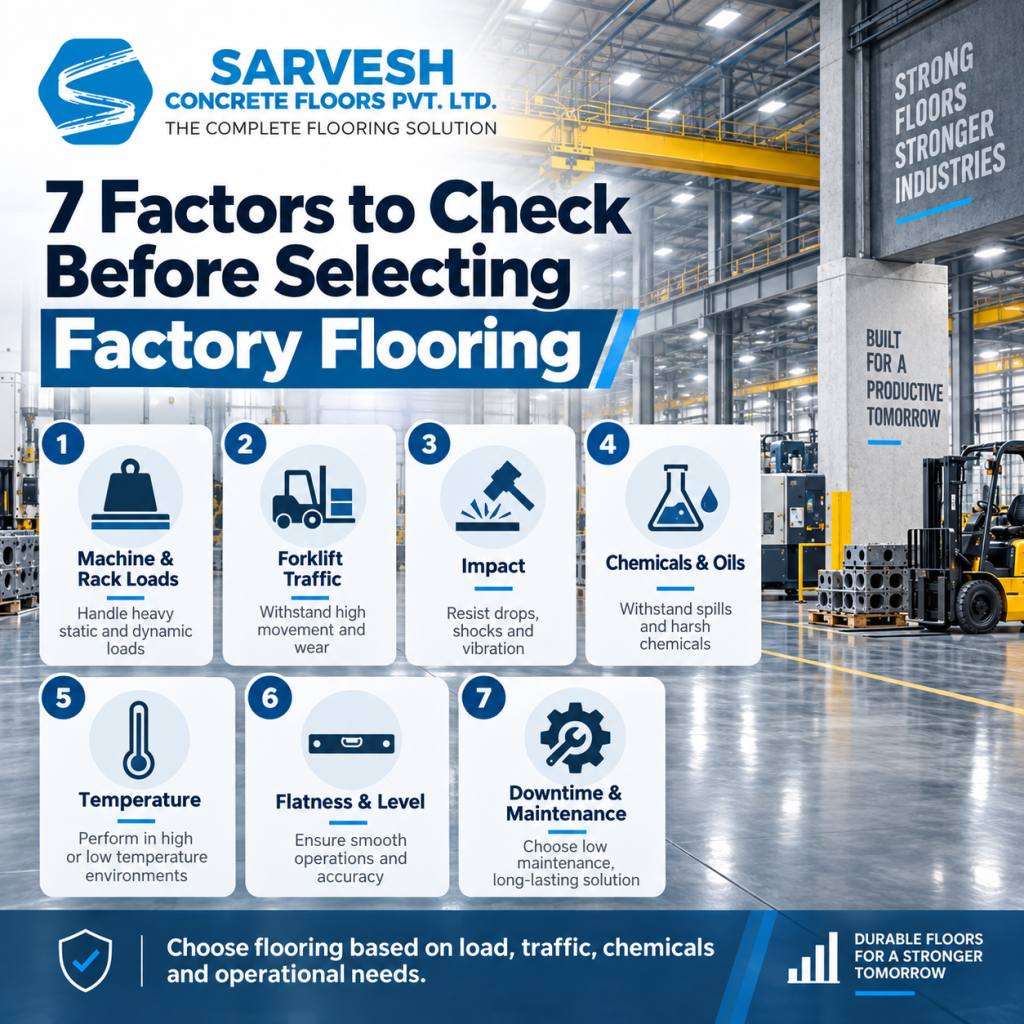
7 Factors to Check Before Selecting Factory Flooring
1. Machine and Rack Loads
Collect equipment weights, base dimensions, anchor details and any dynamic loads. The structural engineer should verify the slab and foundation design.
2. Forklift Traffic
Consider vehicle weight, wheel material, turning frequency and aisle layout. Turning points usually wear faster than straight travel lanes.
3. Impact
Maintenance bays, fabrication areas and loading zones may require a tougher system than assembly areas because dropped components can chip or crack brittle surfaces.
4. Chemicals and Oils
Provide a list of chemicals, concentration, temperature and contact duration to the flooring supplier. “Chemical-resistant” is not a universal rating.
5. Temperature
Hot processes, steam cleaning, ovens, freezers or strong temperature cycling can change the best resin choice and joint detail.
6. Flatness and Level
Manufacturing lines and automated handling may have stricter floor tolerances than general production space. Confirm the required specification before pouring concrete.
7. Downtime and Maintenance
Some systems need several days before full service, while fast-cure options can shorten shutdowns. The project programme should include preparation, curing and reopening criteria.
Frequently Asked Questions
For heavy machinery, the structural load should be carried by a correctly engineered concrete slab or machine foundation. The wearing surface may then use VDF/hardened concrete, epoxy, PU or another industrial system depending on abrasion, chemicals, impact, temperature and cleaning requirements.
Epoxy can be an excellent protective surface around many machines when the concrete slab is structurally adequate. The epoxy itself should not be treated as the structural foundation. Heavy-duty or mortar-grade systems may be chosen where impact and abrasion are severe.
Yes, VDF/Trimix flooring is widely used for factories and warehouses because it creates a dense industrial concrete surface suitable for heavy traffic. Correct mix design, slab design, joints, finishing and curing remain essential.
Neither chemistry is universally better. Epoxy is often preferred for hard, seamless indoor floors, while PU-based systems can be advantageous where flexibility, UV exposure, thermal cycling or certain chemical conditions are important. The process environment should decide the system.
Areas exposed to water, oil, ramps or frequent contamination may need a textured slip-resistant finish. The required texture should balance safety with cleanability and should be selected for the actual operating environment.
Often yes. If the slab is structurally sound, repairs, grinding, densification, resin flooring or local resurfacing may extend service life. Widespread structural failure, settlement or severe deterioration may require more substantial reconstruction.